Introduction to NYC Commercial Design
In the heart of Manhattan’s bustling business landscape, where every square foot counts and first impressions can make or break deals, commercial office interior design has evolved from a luxury to a strategic necessity. New York City’s unique blend of architectural heritage, cutting-edge innovation, and diverse workforce demands a sophisticated approach to workspace design that goes beyond aesthetics.
At DIG Interior Design Solutions, we understand that your office space is more than just a place to work—it’s a physical manifestation of your company culture, a tool for talent retention, and a driver of productivity. With over two decades of experience transforming commercial spaces across Manhattan, Brooklyn, Queens, Staten Island, and the Bronx, our team, led by nationally certified principal designer Deanna D’Addario Martinez, brings unparalleled expertise to every project.
The modern NYC office faces unprecedented challenges: hybrid work models reshaping space utilization, Local Law 97 demanding sustainable practices, and a competitive talent market where workplace quality influences recruitment. This comprehensive guide addresses these challenges head-on, providing actionable insights for business decision-makers ready to transform their workspaces into strategic assets.
Whether you’re renovating a historic Financial District building, optimizing a Midtown high-rise, or creating a startup hub in Brooklyn, this guide will equip you with the knowledge to make informed decisions about your commercial office design project. From understanding NYC’s complex building codes to calculating the ROI of good design, we’ll cover every aspect of creating a workspace that drives performance and reflects your brand’s excellence.
Schedule Your Free Office Design Consultation to discuss how we can transform your NYC workspace into a productivity powerhouse.
Space Planning Fundamentals
Effective space planning forms the foundation of successful commercial office design in NYC, where real estate costs average $80-$150 per square foot annually. Every inch must serve a purpose, balancing employee needs with operational efficiency while maintaining flexibility for future growth.
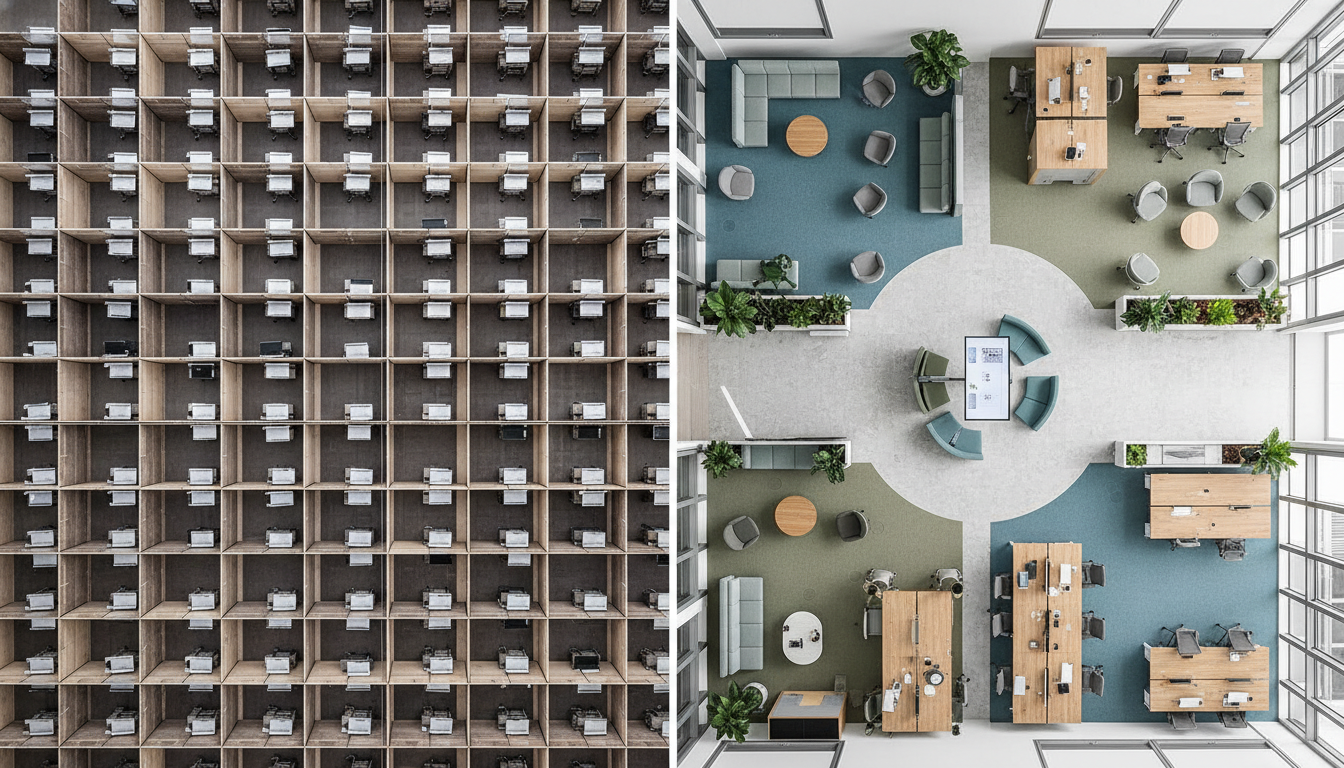
The evolution from traditional cubicle farms to dynamic, activity-based workspaces reflects changing work patterns and employee expectations. Modern NYC offices typically allocate 150-175 square feet per employee, down from 250 square feet a decade ago, requiring innovative approaches to maintain comfort and functionality within compressed footprints.
Strategic space planning begins with understanding your organization’s unique workflow patterns. Financial services firms in Manhattan often require more private offices and secure meeting rooms, while tech startups in Brooklyn might prioritize open collaboration areas and flexible hot-desking arrangements. Our analysis of traffic patterns, departmental interactions, and technology requirements ensures optimal adjacencies that minimize wasted movement and maximize productive interactions.
Circulation paths deserve particular attention in NYC offices, where fire code compliance mandates specific egress widths and distances. We design primary circulation routes at 5-6 feet wide to accommodate peak traffic while maintaining ADA compliance, with secondary paths at 3-4 feet. These arteries don’t just move people—they create opportunities for spontaneous collaboration through strategically placed interaction nodes.
Zoning strategies divide your office into distinct areas based on acoustic requirements and activity types. Focus zones requiring concentration are positioned away from high-traffic areas and equipped with sound-absorbing materials. Collaboration zones feature writable surfaces, flexible furniture, and technology integration for seamless teamwork. Social zones near kitchens and break areas foster culture-building interactions that strengthen team bonds.
The 60-30-10 rule guides our space allocation: 60% for workstations and primary work areas, 30% for meeting spaces and collaboration zones, and 10% for support spaces like storage and equipment rooms. This formula adapts to your specific needs—law firms might increase private office allocation, while creative agencies could expand collaboration areas.
Flexibility remains paramount in today’s rapidly evolving business environment. Modular furniture systems, demountable partitions, and infrastructure planning for easy reconfiguration protect your investment against future changes. We’ve helped numerous Manhattan firms seamlessly transition from traditional layouts to hybrid models without major reconstruction, saving hundreds of thousands in potential renovation costs.
NYC Building Codes & Compliance
Navigating New York City’s complex web of building codes, regulations, and compliance requirements demands specialized expertise that can make or break your office design project. The NYC Department of Buildings, Fire Department, and Department of Health each impose specific requirements that directly impact design decisions, timelines, and budgets.
The 2022 NYC Building Code establishes fundamental parameters for commercial office design. Occupancy load calculations determine maximum capacity at one person per 100 square feet of gross floor area for business use. This calculation drives requirements for exits, restrooms, and ventilation systems. In buildings over 75 feet tall, additional high-rise provisions apply, including pressurized stairwells, emergency voice communication systems, and fire command centers.
Egress requirements shape circulation planning from the outset. Every occupant must have access to at least two exits when floor occupancy exceeds 49 people, with travel distances not exceeding 200 feet to the nearest exit in non-sprinklered buildings or 250 feet in sprinklered spaces. Exit doors must swing in the direction of egress when serving 50 or more occupants, and corridors must maintain minimum widths of 44 inches for occupancy loads over 50.
ADA compliance extends beyond basic accessibility to create truly inclusive workspaces. Beyond the required 36-inch clear paths and 60-inch turning radiuses for wheelchairs, we design for diverse abilities with adjustable workstations, accessible technology interfaces, and sensory considerations for neurodivergent employees. At least 5% of workstations must be fully accessible, with dispersal throughout the office rather than segregation in one area.
Fire safety systems integration requires careful coordination between design and engineering teams. Sprinkler head placement must maintain specific clearances from walls and obstructions while achieving required coverage densities. Exit signage visibility, emergency lighting with 90-minute battery backup, and fire alarm device placement all influence ceiling designs and furniture layouts. Our experience with Staten Island and Bronx projects has taught us to anticipate DOB examiner preferences, streamlining approval processes.
Local Law 97, effective since 2024, mandates aggressive carbon emission reductions for buildings over 25,000 square feet. Office designs must now incorporate energy-efficient lighting achieving at least 0.75 watts per square foot, high-performance HVAC systems, and building envelope improvements. We integrate these requirements from concept development, ensuring compliance doesn’t compromise aesthetic or functional goals.
The NYC Energy Conservation Code requires daylight harvesting in spaces within 15 feet of windows, automatic lighting controls, and plug load management systems. These requirements, often seen as constraints, become design opportunities—we’ve created stunning biophilic office design elements that reduce energy consumption while improving employee wellbeing.
Permit navigation requires strategic sequencing to minimize delays. Alt-2 applications for non-structural work typically process within 8-10 weeks, while Alt-1 applications involving structural changes can extend to 16-20 weeks. We maintain relationships with experienced expeditors who understand each borough’s specific requirements, often reducing approval times by 30-40%.
Design Process Timeline
A successful commercial office design project in NYC follows a structured timeline that balances thorough planning with efficient execution. Understanding each phase’s duration and dependencies helps set realistic expectations and ensures smooth project delivery without costly delays or rushed decisions.
The complete design and construction process for a typical 10,000-15,000 square foot Manhattan office spans 16-24 weeks from initial consultation to move-in ready. Larger projects or those requiring extensive structural modifications may extend to 32-40 weeks. Our proven process, refined through hundreds of NYC projects including our award-winning work in Staten Island and the Bronx, minimizes timeline risks while maintaining design integrity.
Phase 1: Discovery and Programming (Weeks 1-2) The journey begins with comprehensive discovery sessions exploring your business objectives, cultural values, and operational requirements. We conduct employee surveys, workflow analyses, and space utilization studies to understand how your team really works versus how they’re supposed to work. This phase includes initial code review, building assessment, and preliminary budget discussions. Deliverables include a detailed program document outlining space requirements, adjacency matrices, and project goals that guide all subsequent decisions.
Phase 2: Concept Development (Weeks 3-5) Armed with programming insights, our design team develops 2-3 conceptual directions exploring different approaches to your spatial challenges. Each concept includes space plans, 3D visualizations, and mood boards communicating the look and feel. We present furniture typologies, finish palettes, and technology integration strategies. This phase involves intensive client collaboration, with revision rounds ensuring alignment before proceeding. Budget estimates become more refined, typically landing within 10-15% of final costs.
Phase 3: Design Development (Weeks 6-9) The selected concept evolves into detailed design documentation. Floor plans solidify, elevations define vertical surfaces, and reflected ceiling plans coordinate lighting, HVAC, and sprinkler systems. Material selections finalize, furniture specifications develop, and color psychology for productivity guides finish choices. MEP engineers join the team, ensuring infrastructure supports design intent. We submit preliminary drawings to DOB for initial review, identifying potential compliance issues early.
Phase 4: Construction Documentation (Weeks 10-13) Comprehensive construction drawings detail every aspect of the build-out. Dimensioned floor plans, construction details, finish schedules, and millwork drawings provide contractors with precise implementation instructions. Specifications outline quality standards, installation methods, and acceptable substitutions. Bid packages organize documentation for accurate pricing. This phase’s thoroughness directly impacts construction efficiency—complete documentation reduces field questions and change orders by up to 60%.
Phase 5: Permitting and Bidding (Weeks 14-16) Permit applications submit to relevant agencies while contractors prepare detailed bids. We guide selection of qualified contractors familiar with NYC commercial work, evaluating proposals for completeness and value rather than just bottom-line cost. Permit approval timing varies by borough and scope—Manhattan typically processes faster than outer boroughs, though Brooklyn has improved significantly. We maintain constant communication with plan examiners, addressing comments quickly to avoid delays.
Phase 6: Construction and Installation (Weeks 17-22) Construction proceeds in logical sequences minimizing business disruption. Demolition and rough framing establish spatial boundaries, followed by MEP rough-ins. Wall framing, drywall, and initial finishing create defined spaces. Flooring, painting, and final finishes transform raw construction into designed environments. Furniture installation, technology integration, and final styling complete the transformation. We conduct weekly site visits ensuring design intent translates accurately to built reality.
Phase 7: Post-Occupancy Support (Weeks 23-24) Move-in coordination ensures smooth transition to your new space. We oversee furniture placement, artwork installation, and final adjustments. A thorough punch list process addresses any outstanding items. Post-occupancy evaluations after 30 and 90 days identify adjustment needs as teams settle into new work patterns. This feedback loop informs future projects and validates design decisions.
Fast-track scheduling can compress timelines by overlapping phases, though this increases coordination complexity and risk. Phased construction allows partial occupancy during renovation, maintaining business operations. Weekend and after-hours work minimizes disruption but increases costs by 20-30%.
Budget Planning Guide
Creating a realistic budget for commercial office interior design in NYC requires understanding both hard costs and soft costs while building in appropriate contingencies for the inevitable surprises that arise in urban construction. Manhattan office renovations typically range from $100-$200 per square foot for standard improvements to $250-$400 per square foot for high-end build-outs with extensive infrastructure upgrades.
Breaking Down the Budget Components
Construction costs comprise 60-70% of total project investment. This includes demolition ($5-$10/SF), framing and drywall ($15-$25/SF), mechanical/electrical/plumbing upgrades ($25-$45/SF), flooring ($8-$15/SF), painting and finishes ($5-$8/SF), and millwork ($20-$40/SF). Premium finishes, complex geometries, or extensive glass partitions push costs toward the higher ranges. Our recent Financial District project achieved stunning results at $135/SF through strategic material selection and value engineering.
Furniture, fixtures, and equipment (FF&E) represent 20-25% of total budget. Workstation costs vary dramatically: basic systems furniture runs $1,500-$3,000 per seat, while premium ergonomic solutions reach $5,000-$8,000. Conference room furniture for a 12-person room ranges from $8,000-$25,000 depending on technology integration. Ancillary furniture—lounge seating, café tables, storage—adds $500-$1,500 per person. We leverage our vendor relationships to secure 15-25% discounts off list prices.
Professional fees account for 8-12% of construction costs. Architectural and interior design services typically run 8-10% for full-service engagement. Engineering consultants (MEP, structural, IT) add 3-5%. Specialized consultants for lighting, acoustics, or sustainability might add 1-2%. While tempting to minimize, adequate professional services reduce costly errors and change orders that can exceed initial savings by 300-400%.
Permit and regulatory costs in NYC are substantial but predictable. Building permit fees calculate at approximately $0.35 per square foot for new construction value. Plan examination fees, electrical permits, and plumbing permits add several thousand dollars. Expeditor services ($5,000-$15,000) often prove worthwhile for timeline compression. Environmental assessments, required for older buildings, run $3,000-$8,000.
Technology infrastructure increasingly drives budget requirements. Basic data/voice cabling costs $8-$12/SF, while robust wireless systems with comprehensive coverage add $5-$8/SF. Audio/visual systems for conference rooms range from $15,000-$50,000 per room. Hybrid workplace solutions require additional investment in video conferencing and collaboration technology, typically adding 15-20% to technology budgets.
Moving and temporary workspace costs often surprise clients. Professional moving services in Manhattan run $3-$5 per square foot. Temporary workspace during construction might cost $50-$100 per person per day. Storage for existing furniture adds $200-$500 per month per truckload. Business interruption—lost productivity during transition—can equal 5-10% of project cost if not properly managed.
Contingency Planning and Risk Management
Contingency reserves of 10-15% protect against unknowns. Older buildings require higher contingencies (15-20%) due to potential asbestos, structural surprises, or outdated systems. Our Chelsea renovation uncovered 1920s knob-and-tube wiring requiring complete electrical replacement, consuming the entire contingency but preventing future failures.
Value engineering identifies cost reduction opportunities without compromising design intent. Substituting materials with similar aesthetics but lower costs, simplifying complex details, or phasing improvements can reduce budgets by 10-20%. However, cutting too deeply often creates false economies—cheaper furniture requiring replacement in three years costs more than quality pieces lasting a decade.
Financing options extend beyond traditional bank loans. Furniture leasing preserves capital while providing tax advantages. Tenant improvement allowances from landlords offset significant costs—Manhattan Class A buildings often provide $60-$100/SF for qualified tenants. Energy efficiency incentives from Con Edison and NYSERDA can offset 20-30% of qualifying improvements.
Budget phasing allows spreading costs over multiple fiscal periods. Phase 1 might address critical infrastructure and primary workspace needs, Phase 2 adds collaboration areas and amenities, Phase 3 completes aesthetic upgrades and branded elements. This approach maintains business operations while managing cash flow.
Get Your Free Office Design Consultation to receive a detailed budget estimate tailored to your specific needs and objectives.
Productivity-Focused Layouts
The correlation between thoughtful office design and employee productivity has evolved from intuition to science, with studies demonstrating that optimized workspaces can increase productivity by 15-25% while reducing absenteeism and improving talent retention. In NYC’s competitive business environment, where talent costs often exceed real estate expenses, productivity-focused design delivers measurable ROI.
Activity-based working (ABW) principles recognize that different tasks require different environments. Rather than assigning fixed desks, ABW provides diverse settings optimized for specific activities. Focus work demands quiet, enclosed spaces with minimal visual distraction. Collaboration thrives in open areas with writable surfaces and flexible furniture. Phone calls need acoustic privacy without full enclosure. Creative thinking benefits from informal, comfortable settings with natural light and views.
Our analysis of workspace utilization across Manhattan offices reveals that traditional assigned desks sit empty 50-60% of the time due to meetings, travel, and remote work. By right-sizing the workspace mix—typically 70% shared/flexible and 30% assigned—clients achieve 30-40% space reduction while improving employee satisfaction. A Financial District client reduced their footprint from 25,000 to 17,000 square feet while accommodating 20% staff growth through intelligent ABW implementation.
Cognitive ergonomics extends beyond physical comfort to mental wellbeing. Desk positioning away from high-traffic areas reduces interruption-based productivity loss, which studies show can cost 23 minutes per disruption to regain focus. Strategic placement of visual barriers—plants, screens, artwork—creates psychological boundaries without full enclosure. Color temperature variation, with cooler light (5000K) in focus areas and warmer tones (3000K) in social spaces, supports natural circadian rhythms.
The “collision theory” popularized by tech companies strategically increases chance encounters that spark innovation. Central stairs between floors, single coffee stations serving multiple departments, and circulation paths through collaborative areas create “collision points.” However, forced interaction backfires—we balance collision opportunities with escape routes for introverted team members or deadline-driven work.
Biophilic design elements demonstrably improve cognitive function and stress reduction. Views of nature or urban greenspace increase productivity by 6-8%. Indoor plants improve air quality while reducing stress markers by 37%. Water features provide acoustic masking while triggering psychological calm. Our Tabernacle Steakhouse project successfully integrated these elements into a sophisticated hospitality environment, principles we’ve adapted for corporate clients seeking similar ambiance benefits.
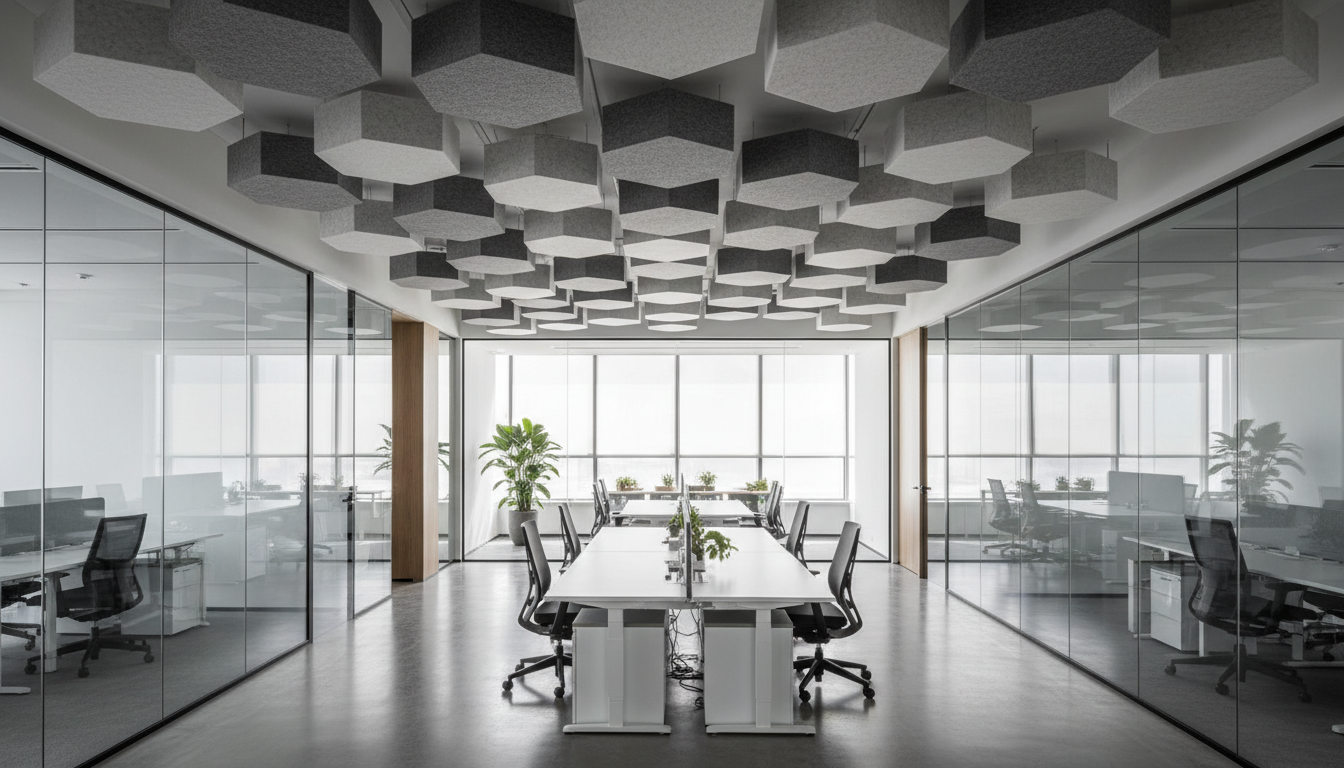
Acoustic design critically impacts productivity, with studies showing that office noise reduces performance by up to 66% for complex cognitive tasks. We specify NRC (Noise Reduction Coefficient) ratings of 0.70 or higher for open office ceilings, using acoustic clouds, baffles, or tiles. Sound-absorbing furniture, carpet tiles, and wall treatments achieve optimal reverberation times of 0.6-0.8 seconds. Phone booth installations provide quick acoustic refuge for calls or focused work.
Technology integration streamlines workflows and reduces friction. Wireless presentation systems eliminate cable hunting and connection delays. Room booking systems with presence sensors optimize space utilization while preventing conflicts. Sit-stand desks with memory settings support ergonomic variety. Environmental controls allowing personal adjustment of temperature and lighting improve satisfaction by 25% while reducing facilities complaints by 40%.
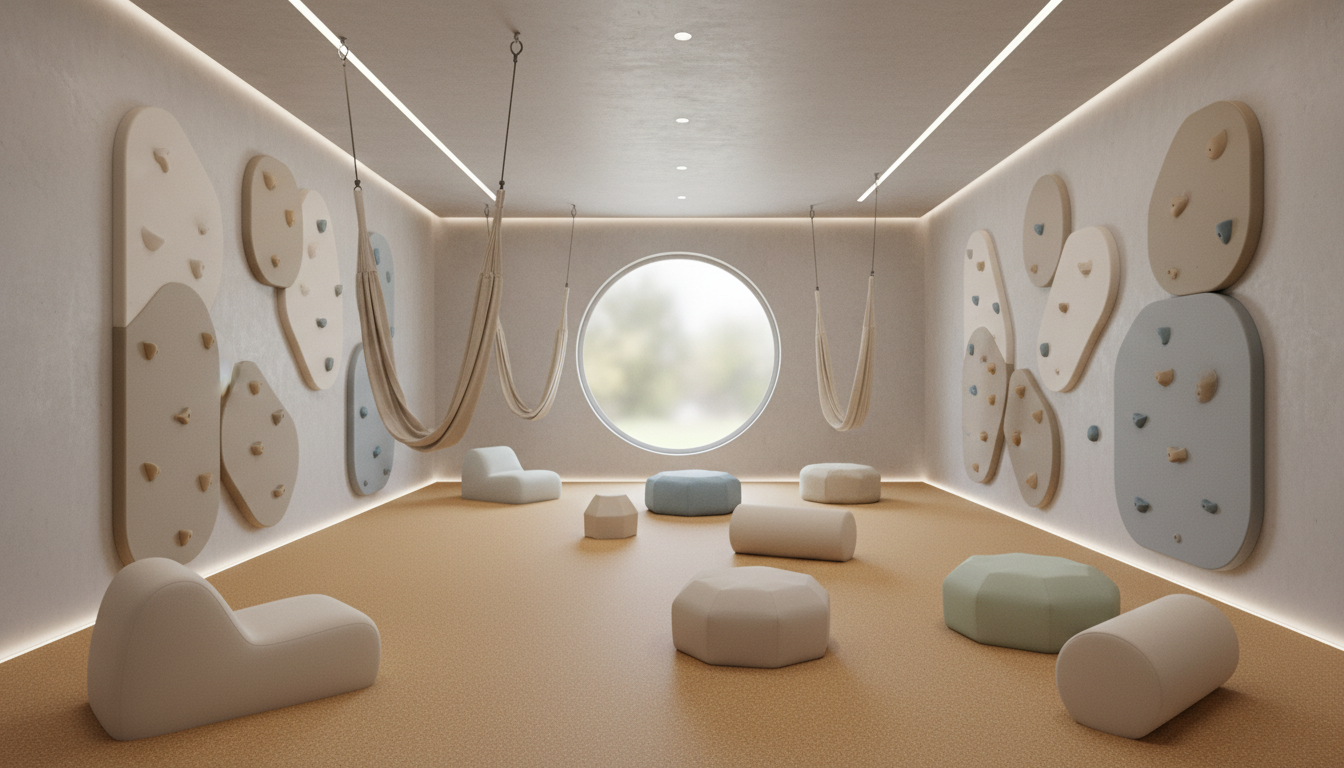
Wellness-focused amenities directly impact productivity metrics. On-site fitness facilities correlate with 2.5 fewer sick days annually per employee. Mothers’ rooms support returning parents. Quiet rooms provide space for meditation, prayer, or simply decompression. Healthy food options and filtered water stations improve energy levels and reduce afternoon productivity dips.
The measurement of productivity improvements requires baseline establishment before renovation and consistent tracking afterward. Key performance indicators include employee satisfaction surveys, space utilization metrics, absenteeism rates, and when possible, direct output measurements. Our post-occupancy evaluations consistently show 12-18% productivity improvements, with some achieving 25% or higher through comprehensive workplace transformation.
Technology Integration
Modern commercial offices in NYC demand sophisticated technology infrastructure that seamlessly supports hybrid work models, enables global collaboration, and adapts to rapidly evolving digital tools. Technology integration must be considered from project inception rather than retrofitted, as infrastructure requirements significantly impact design decisions, construction sequencing, and budget allocation.
Robust network architecture forms the digital backbone of productive workspaces. Category 6A cabling supports 10-gigabit speeds necessary for video conferencing, cloud computing, and future applications. We specify redundant pathways with 40% spare capacity for future expansion. Wireless access points placed on 30-40 foot centers ensure comprehensive coverage with -65 dBm or better signal strength. Mesh networks provide seamless roaming between access points, critical for video calls while walking.
Power distribution requires careful planning to support increasing device loads. Modern workstations need 6-8 outlets minimum: computer, monitor(s), phone charger, desk light, personal devices, and future flexibility. We specify at least two circuits per 4-pack of workstations to prevent overloading. Floor boxes in open areas eliminate dangerous extension cords while maintaining flexibility. USB-A and USB-C outlets integrated into furniture reduce adapter clutter.
Conference room technology elevates meeting effectiveness while supporting hybrid participation. Native Microsoft Teams or Zoom Rooms provide one-touch joining with calendar integration. Dual displays allow simultaneous content sharing and remote participant viewing. Ceiling-mounted microphone arrays with beam-forming technology ensure clear audio pickup without table clutter. Automated cameras track speakers, creating engaging experiences for remote attendees. Our Midtown installations consistently achieve 95%+ user satisfaction scores.
Digital signage and wayfinding reduce confusion while reinforcing brand messaging. Lobby displays welcome visitors with branded content and directory information. Meeting room displays show availability and upcoming reservations. Digital menu boards in café areas update automatically with daily offerings. Emergency notification integration ensures rapid communication during incidents. Content management systems allow marketing teams to update messaging without IT involvement.
Security systems protect both physical and digital assets. Access control systems using smartphone credentials eliminate lost keycards while providing detailed audit trails. Integrated video surveillance with AI-powered analytics identifies unusual activity patterns. Visitor management systems streamline check-in while maintaining security protocols. Network segmentation isolates guest WiFi from corporate resources, preventing unauthorized access.
Environmental control systems balance comfort with efficiency. Smart thermostats learn occupancy patterns, reducing energy consumption by 20-30% through intelligent scheduling. Automated blinds respond to sun position and glare sensors, maintaining visual comfort while maximizing natural light. CO2 sensors trigger ventilation increases when conference rooms fill, maintaining cognitive performance. Integration with booking systems pre-conditions spaces before scheduled meetings.
Collaboration technology extends beyond video conferencing to enable true hybrid work. Digital whiteboards synchronize between physical and virtual participants, capturing brainstorms for later reference. Wireless presentation systems allow instant screen sharing from any device. Cloud-based phone systems follow employees between office, home, and mobile. Hot desk booking applications remember personal preferences, automatically adjusting sit-stand heights and monitor positions.
Future-proofing strategies protect technology investments against rapid obsolescence. Modular systems allow component upgrades without complete replacement. Standards-based solutions ensure interoperability as vendors change. Service-oriented architecture enables cloud migration as applications evolve. Regular technology audits identify emerging needs before they become critical limitations.
Internet of Things (IoT) sensors provide unprecedented insight into space utilization and environmental conditions. Occupancy sensors track real-time usage, informing space planning decisions with actual data rather than assumptions. Environmental sensors monitor temperature, humidity, CO2, and noise levels, automatically generating maintenance tickets when parameters exceed thresholds. Energy monitoring identifies consumption patterns, revealing optimization opportunities that reduce operating costs by 15-25%.
Sustainability Features
Sustainability in commercial office design has evolved from a nice-to-have to a business imperative, driven by Local Law 97 compliance requirements, corporate ESG commitments, and employee expectations. NYC offices implementing comprehensive sustainability strategies achieve 30-40% energy cost reductions while improving employee health and productivity.
Local Law 97, New York City’s groundbreaking climate legislation, mandates 40% emissions reduction by 2030 and 80% by 2050 for buildings over 25,000 square feet. Non-compliance triggers substantial fines—$268 per metric ton over the limit annually. Our sustainability-first approach ensures current compliance while future-proofing against tightening standards. Early adopters gain competitive advantages through reduced operating costs and enhanced reputation among environmentally conscious talent and clients.
Energy-efficient lighting systems deliver immediate impact with rapid payback periods. LED fixtures consuming 0.5-0.7 watts per square foot replace legacy fluorescent systems using 1.5-2.0 watts. Daylight harvesting systems with photosensors automatically dim perimeter lights based on available natural light, reducing consumption by an additional 20-30%. Occupancy sensors ensure lights operate only when needed. Task lighting allows reduced ambient levels while maintaining workspace functionality. Our Brooklyn projects consistently achieve 50-60% lighting energy reduction.
HVAC optimization balances comfort with efficiency through intelligent design and controls. Variable refrigerant flow (VRF) systems provide zone-specific conditioning, eliminating energy waste from conditioning unused spaces. Demand-controlled ventilation adjusts fresh air intake based on CO2 levels rather than fixed schedules. Energy recovery ventilators capture heating/cooling from exhaust air, reducing conditioning loads by 30-40%. Smart thermostats with occupancy-based scheduling prevent conditioning empty spaces.
Material selection significantly impacts both embodied carbon and indoor air quality. We prioritize materials with Environmental Product Declarations (EPDs) documenting lifecycle impacts. Recycled content reduces virgin material extraction—recycled steel studs, reclaimed wood, recycled-content carpet tiles. Regional materials sourced within 500 miles reduce transportation emissions. Low-VOC paints, adhesives, and sealants improve indoor air quality while reducing atmospheric pollution. Cradle-to-cradle certified products ensure end-of-life recyclability.
Water conservation measures reduce consumption by 30-40% through efficient fixtures and behavioral design. Low-flow faucets with 0.5 GPM aerators maintain functionality while reducing usage. Dual-flush toilets differentiate between liquid and solid waste. Bottle-filling stations encourage reusable containers while tracking plastic bottles saved. Leak detection systems identify problems before they waste thousands of gallons. Native drought-tolerant plants in office environments eliminate irrigation requirements.
Waste reduction strategies divert 75-90% of materials from landfills. Construction waste management plans segregate materials for recycling—metal, concrete, gypsum, cardboard. Modular construction systems enable future reconfiguration without demolition. Centralized recycling stations with clear signage improve compliance. Composting programs for organic waste from office kitchens create circular resource loops. Digital document management reduces paper consumption by 60-80%.
Indoor environmental quality improvements enhance employee health while reducing absenteeism. MERV 13 or higher filters remove particulates including viruses and allergens. Increased ventilation rates of 30 CFM per person exceed code minimums, improving cognitive function. Green cleaning programs eliminate toxic chemicals from maintenance routines. Biophilic design elements improve air quality while providing psychological benefits. Daylighting strategies reduce artificial lighting needs while supporting circadian rhythms.
Renewable energy integration offsets remaining consumption after efficiency improvements. Solar film windows generate electricity while reducing glare and heat gain. Power purchase agreements provide renewable energy without capital investment. Battery storage systems provide resilience during grid outages while enabling load shifting for cost optimization. Building-integrated photovoltaics serve dual functions as architectural elements and energy generators.
LEED certification provides third-party validation of sustainability achievements while offering marketing advantages. We guide clients through certification levels—Certified (40-49 points), Silver (50-59), Gold (60-79), or Platinum (80+). Our project teams include LEED Accredited Professionals ensuring documentation completeness. Benefits include expedited permitting, tax incentives, and increased property values averaging 7-9% premium for LEED Gold buildings.
Performance monitoring ensures sustained benefits through ongoing optimization. Building management systems track energy consumption, identifying anomalies requiring attention. Regular retrocommissioning maintains peak efficiency as systems age and usage patterns evolve. Employee engagement programs encourage sustainable behaviors—turning off equipment, minimizing printing, using stairs for short trips. Sustainability dashboards in lobbies showcase achievements while maintaining awareness.
Case Studies
Real-world transformations demonstrate how strategic commercial office design drives measurable business outcomes. These NYC projects showcase our ability to navigate complex challenges while delivering spaces that exceed expectations.
Tabernacle Steakhouse: Hospitality Excellence Meets Corporate Innovation
While primarily known for hospitality design, our Tabernacle Steakhouse project in Midtown Manhattan demonstrates principles directly applicable to corporate environments. The 8,500 square foot space required sophisticated acoustic management to balance energetic bar atmosphere with intimate dining experiences—challenges paralleling open office acoustics.
The barrel-vaulted ceiling, beyond its stunning aesthetic impact, serves multiple functional purposes. Curved surfaces diffuse sound rather than creating harsh reflections common with flat ceilings. Integrated acoustic treatments achieve 0.7 second reverberation times optimal for conversation. Specialized HVAC design maintains consistent temperatures despite 20-foot ceiling heights, principles we’ve applied to dramatic corporate lobbies and atriums.
Material selection balanced durability with luxury—leather banquettes withstand commercial use while providing acoustic absorption. Custom millwork conceals technology infrastructure while maximizing storage efficiency. The private dining room’s flexible configuration accommodates 12-40 guests through moveable partitions, demonstrating space flexibility valuable for corporate conference centers.
The project’s success—30% revenue increase within six months—validates design‘s impact on business performance. Online reviews consistently praise the atmosphere, with ambiance mentions increasing 300%. These hospitality lessons translate directly to corporate projects where employee experience drives retention and recruitment.
Staten Island Corporate Headquarters: Maximizing Efficiency in Suburban Settings
A 15,000 square foot corporate headquarters renovation in Staten Island transformed a dated 1980s building into a modern, efficient workspace. The financial services client required enhanced security, improved collaboration spaces, and energy efficiency improvements to achieve carbon neutrality goals.
The design challenge involved maintaining operations during renovation—critical for the trading floor operating during market hours. We implemented a three-phase construction approach, relocating departments sequentially to minimize disruption. Weekend technology cutovers ensured zero trading days lost. The phased approach added only 15% to timeline while saving an estimated $500,000 in temporary relocation costs.
Security requirements demanded creative solutions balancing openness with protection. Glazed partitions with smart film technology provide instant privacy for sensitive meetings. Biometric access controls integrate seamlessly with architectural elements. Visitor circulation routes prevent unauthorized access to trading areas while maintaining welcoming reception experience. The secure design achieved FINRA compliance without creating fortress-like atmosphere.
Energy improvements reduced consumption by 42% despite adding 20% more workstations. Daylight harvesting, LED retrofits, and upgraded HVAC systems drove savings. The conference room’s videoconferencing capabilities eliminated 60% of travel to Manhattan, reducing costs and carbon footprint. The project achieved LEED Gold certification, enhancing corporate sustainability credentials.
Employee satisfaction scores increased 35% post-renovation, with particular praise for the new café and outdoor terrace. Recruitment success improved with candidates citing the workspace as a decision factor. Absenteeism decreased 20%, attributed to improved air quality and natural light access. The $2.1 million investment generated positive ROI within 18 months through energy savings and productivity improvements.
Brooklyn Tech Startup: Agile Design for Rapid Growth
A 12,000 square foot Brooklyn tech startup space demonstrates adaptive design supporting 300% growth over three years. The initial 40-person team has expanded to 160 while maintaining cultural identity and operational efficiency through flexible infrastructure and modular systems.
The design anticipated growth through strategic infrastructure investments. Oversized electrical and data pathways accommodate additional workstations without ceiling demolition. Modular furniture systems reconfigure as teams restructure. Demountable glass partitions create offices as leadership expands. The kitchen and bathrooms sized for 200 occupants prevented costly renovations during expansion.
Collaboration technology supports distributed teams across time zones. Every surface becomes presentable through strategic display placement and wireless connectivity. Phone booths added incrementally as density increased, maintaining acoustic comfort. The all-hands space doubles as event venue, generating revenue while building industry connections.
Budget constraints required creative solutions maximizing impact. Polished concrete floors eliminated finishing costs while providing durability. Exposed ceilings painted black create industrial aesthetic while simplifying maintenance. Custom plywood millwork provides branded elements at fraction of traditional costs. Local artist murals create unique identity supporting recruitment efforts.
The space has become a talent magnet, with 90% of new hires citing workspace as joining factor. Productivity metrics show 22% improvement in project completion rates. Client visits increased 200% with the space serving as competitive differentiator. The initial $1.5 million investment has supported $50 million revenue growth without requiring major renovations.
ROI of Good Design
Quantifying the return on investment for commercial office design transforms perception from cost center to strategic investment. NYC businesses implementing comprehensive design improvements average 3:1 ROI within three years through combined productivity gains, operating cost reductions, and talent advantages.
Productivity improvements drive the largest returns, though measurement requires discipline. A 5% productivity gain for 100 employees averaging $75,000 salary equals $375,000 annual value—often exceeding entire renovation amortization. Our post-occupancy studies across Manhattan offices document 12-18% average productivity improvements through:
- Reduced time waste from poor wayfinding or inadequate meeting spaces (saving 30 minutes daily per employee)
- Fewer sick days through improved air quality and ergonomics (2.5 days annually per employee)
- Faster project completion through better collaboration spaces (15% reduction in project timelines)
- Reduced errors from noise and distraction (20% decrease in rework requirements)
- Enhanced creativity and innovation through inspiring environments (25% increase in new idea generation)
Talent acquisition and retention benefits prove equally valuable in NYC’s competitive market. Recruitment costs average $15,000-$25,000 per professional hire. Reducing turnover by just 10% saves $150,000-$250,000 per 100 employees annually. Our clients report:
- 30% reduction in time-to-hire with impressive spaces supporting recruitment
- 25% improvement in offer acceptance rates
- 20% reduction in turnover within two years of renovation
- 40% increase in employee referrals
- 35% improvement in Glassdoor ratings mentioning workplace environment
Operating cost reductions provide measurable hard-dollar savings:
- Energy efficiency improvements reducing costs 25-35% ($3-5 per square foot annually)
- Space optimization eliminating 20-30% of leased area ($16-24 per square foot in Manhattan)
- Reduced maintenance through durable material selection (30% reduction in facilities tickets)
- Technology integration eliminating redundant systems (15% IT cost reduction)
- Improved space utilization avoiding expansion needs (deferring $1-2 million in relocation costs)
Brand value enhancement impacts revenue through client perception:
- 60% of clients report that office environment influences vendor selection
- Premium pricing power increases 5-10% with sophisticated spaces
- Client retention improves 15% with impressive meeting facilities
- Partnership opportunities increase through event-worthy spaces
- Media coverage and social sharing amplify marketing efforts
Health and wellness improvements reduce healthcare costs while improving performance:
- Ergonomic workstations reduce workers’ compensation claims by 40%
- Improved air quality decreases respiratory issues by 30%
- Natural light access reduces seasonal affective disorder impacts
- Active design encouraging movement reduces cardiovascular risks
- Stress reduction through biophilic design decreases mental health claims
Sustainability benefits extend beyond compliance to competitive advantage:
- Local Law 97 compliance avoids fines potentially reaching $500,000 annually
- LEED certification increases property values 7-9%
- Energy cost reductions of $3-5 per square foot annually
- Corporate sustainability goals supporting ESG reporting
- Attraction of environmentally conscious clients and employees
To calculate project-specific ROI, we employ comprehensive modeling incorporating:
- Baseline Metrics: Current productivity levels, operating costs, turnover rates
- Improvement Projections: Conservative estimates based on similar projects
- Investment Requirements: Total project costs including soft costs and disruption
- Timeline Considerations: Phasing impacts and ramp-up periods
- Risk Adjustments: Sensitivity analysis for various scenarios
A typical $2 million renovation for 10,000 square feet (100 employees) generates:
- Year 1: $400,000 in energy savings and productivity gains (20% ROI)
- Year 2: $600,000 including full productivity realization (30% cumulative ROI)
- Year 3: $650,000 with talent and brand benefits (97% cumulative ROI)
- Years 4-10: $500,000 annually in sustained benefits
These returns assume conservative 10% productivity improvement, 20% energy reduction, and 15% turnover decrease. High-performing designs achieving 20% productivity gains double these returns. The compounding effect over 10-year lease terms generates 5-10x total ROI.
Design quality directly correlates with ROI achievement. Cutting corners through value engineering often eliminates the very features driving returns. A cheaper chair saving $200 but causing back problems costs thousands in lost productivity. Eliminating acoustic treatments to save $50,000 can reduce productivity by millions. Our value optimization approach maintains ROI-driving elements while finding savings in less impactful areas.
Schedule Your Free Office Design Consultation to discover your space’s ROI potential with a customized analysis.
Moving Forward: Your Next Steps
Transforming your NYC commercial office from a functional workspace into a strategic asset requires vision, expertise, and decisive action. Whether you’re planning a complete renovation or targeted improvements, success depends on choosing the right partner and approach for your unique situation.
Immediate Actions You Can Take Today:
Start by conducting an honest assessment of your current space’s performance. Survey employees about pain points—uncomfortable temperatures, insufficient meeting rooms, poor lighting, or technology frustrations. Track space utilization through observation or sensors to identify underused areas. Review energy bills and maintenance costs to establish baselines. Document compliance issues that could trigger fines or safety concerns. These insights inform priorities and support budget justifications.
Create a vision statement defining your ideal workspace outcomes. Beyond aesthetics, what should your office achieve? Improved collaboration? Enhanced innovation? Better client impressions? Stronger culture? Clear objectives guide design decisions and prevent scope creep. Involve key stakeholders early—executive leadership for strategic alignment, HR for talent perspectives, IT for technology requirements, and facilities for operational insights.
Establish realistic budgets and timelines aligned with business cycles. Q3-Q4 planning enables Q1 execution when business disruption is often minimal. Multi-year capital planning allows phased improvements spreading costs while maintaining momentum. Consider lease expiration timing—major renovations make most sense with 5+ years remaining, though improvement allowances might justify earlier action.
Selecting the Right Design Partner:
Your choice of design firm significantly impacts project success. Look beyond pretty portfolios to evaluate relevant experience. Have they completed similar projects in your industry? Do they understand NYC’s unique regulatory environment? Can they demonstrate measurable results from past projects?
At DIG Interior Design Solutions, our multi-sector expertise spanning corporate, healthcare, hospitality, and senior living environments provides cross-pollination of innovative ideas. Our principal, Deanna D’Addario Martinez, brings nationally certified credentials and decades of NYC-specific experience. Our Staten Island corporate project, Bronx wellness center, and the acclaimed Tabernacle Steakhouse demonstrate our range and capability.
Request detailed proposals outlining design process, timeline, team members, and fee structures. Beware of unusually low fees that might indicate inexperience or incomplete services. Evaluate communication styles—you’ll work closely with this team for months. Check references thoroughly, asking about budget adherence, timeline management, and problem resolution. Visit completed projects if possible to experience the spaces firsthand.
Making the Business Case:
Securing stakeholder buy-in requires compelling financial and strategic justification. Develop comprehensive proposals incorporating:
- Productivity impact modeling showing even conservative gains justify investment
- Competitive analysis demonstrating how workplace quality affects talent acquisition
- Compliance requirements and associated fine avoidance
- Energy savings projections with utility incentive opportunities
- Lease analysis comparing renovation versus relocation costs
- Phasing options allowing budget distribution across fiscal periods
Frame the investment in business terms—cost per employee, ROI timeline, strategic advantages—rather than construction costs alone. A $2 million renovation for 100 employees equals $20,000 per person over a 10-year lease—less than half of one hire’s recruitment cost. Position design as investment in human capital, your most valuable asset.
Partnering with DIG Interior Design Solutions:
Our proven process minimizes risk while maximizing value:
- Complimentary Consultation: We begin with a no-obligation workspace assessment, touring your current space, discussing challenges and opportunities, and providing initial recommendations.
- Strategic Programming: Our discovery process uncovers hidden opportunities and challenges, ensuring design solutions address root causes rather than symptoms.
- Creative Excellence: Our designs balance aesthetic impact with functional performance, creating spaces that inspire while supporting productivity.
- Technical Expertise: We navigate NYC’s complex regulatory environment efficiently, avoiding costly delays and compliance issues.
- Project Management: Our systematic approach ensures on-time, on-budget delivery with minimal business disruption.
- Post-Occupancy Support: We remain engaged after move-in, fine-tuning spaces based on actual use patterns and evolving needs.
The Cost of Inaction:
Delaying workspace improvements carries hidden costs that compound over time:
- Lost productivity from poor work environments ($500-$1,000 per employee monthly)
- Talent loss to competitors with better workspaces (replacement costs of 150% annual salary)
- Energy waste from inefficient systems ($3-5 per square foot annually)
- Compliance fines for accessibility or safety violations (potentially hundreds of thousands)
- Competitive disadvantage as rivals modernize their spaces
- Employee disengagement from uninspiring environments (31% productivity impact)
Each month of delay represents lost opportunities for improvement. While planning thoroughly is important, analysis paralysis prevents progress. Our phased approach allows starting with high-impact improvements while planning comprehensive transformations.
Your Competitive Advantage Awaits:
In Manhattan’s hypercompetitive business environment, your workspace can differentiate your organization. Whether attracting top talent, impressing clients, or optimizing operations, strategic design delivers measurable advantages. Our portfolio across Staten Island, the Bronx, Brooklyn, and Manhattan demonstrates consistent success transforming workspaces into competitive assets.
The question isn’t whether to improve your workspace, but how quickly you can capture available benefits. With construction costs rising 3-5% annually and lease terms ticking away, earlier action generates greater returns. Local Law 97’s tightening requirements make energy improvements increasingly urgent. The talent war shows no signs of abating, making workplace quality ever more critical.
Schedule Your Free Office Design Consultation Today
Contact DIG Interior Design Solutions to begin your workspace transformation:
During your complimentary consultation, we’ll:
- Tour your current space and identify improvement opportunities
- Discuss your business objectives and workspace challenges
- Share relevant case studies and success stories
- Provide preliminary budget ranges and timeline estimates
- Outline potential next steps without obligation
Don’t let another quarter pass in suboptimal space. Your employees deserve an environment that supports their best work. Your clients expect spaces that reflect your professionalism. Your stakeholders demand efficient operations and smart investments.
The transformation begins with a single decision: choosing to create a workspace worthy of your organization’s ambitions. With DIG Interior Design Solutions as your partner, that transformation becomes not just possible but inevitable.
Transform your NYC office into a productivity powerhouse. Schedule your free consultation today and discover how strategic design drives business success.
DIG Interior Design Solutions specializes in commercial office, healthcare, hospitality, and senior living design throughout New York City. Our award-winning team, led by nationally certified principal designer Deanna D’Addario Martinez, brings decades of experience creating spaces that inspire, perform, and endure. From our Staten Island corporate projects to our Bronx wellness centers and the acclaimed Tabernacle Steakhouse, we deliver design excellence that transforms businesses.
Contact us today to begin your workspace transformation journey.