
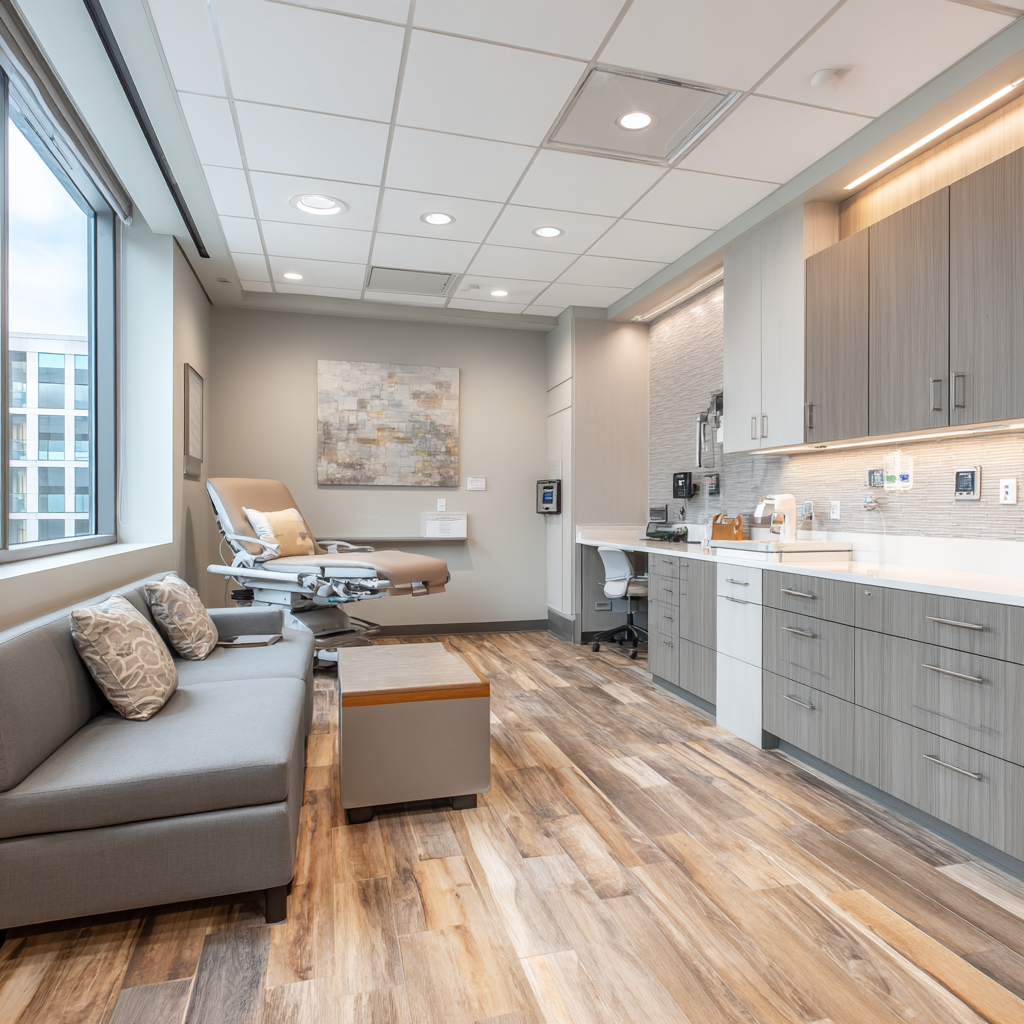
The shift toward outpatient care is no longer a trend, it’s an operational mandate. Health systems across New York and the broader Northeast are actively moving procedures, diagnostics, and routine care out of hospital settings and into ambulatory environments. The drivers are clear: cost control, patient expectations, and reimbursement pressure. What’s less clear, and where many projects struggle, is how to design these facilities to actually perform under real-world conditions.
Outpatient clinics are expected to do more with less: higher patient volumes, tighter staffing models, and faster turnaround times. Designing for that reality requires more than efficient layouts. It requires a clear understanding of how these environments operate when they’re under pressure, not just how they look on a plan.
Throughput Is a Financial Driver, Not a Design Preference
In outpatient settings, throughput directly impacts revenue. The number of patients a clinic can move through safely and efficiently in a day is not an abstract metric, it’s the core business model.
Where projects typically break down is in the gap between planned capacity and actual operational flow. On paper, room counts may align with projections. In practice, circulation, adjacencies, and support space placement determine whether that volume is achievable.
We routinely see exam rooms sized correctly, but turnover slows down because clean/dirty rooms, supply storage, or staff work zones are pushed too far from the point of care. That distance adds minutes to every cycle. Over the course of a day, that’s not a minor inefficiency, it’s a reduction in total patient volume.
Throughput is not solved by adding more rooms. It’s solved by aligning layout with how staff actually move, how patients are staged, and how quickly spaces can reset between uses. If those elements aren’t coordinated early, the facility will underperform from day one.
Staffing Constraints Are Driving Layout Decisions
Staffing shortages are no longer a temporary condition—they are a baseline assumption. Clinics are being designed to operate with leaner teams, which fundamentally changes how space should be organized.
Decentralized layouts that rely on higher staffing levels are increasingly difficult to sustain. In contrast, centralized support zones allow fewer staff to maintain visibility and control across larger areas. This isn’t just a design preference—it’s a response to labor realities.
Visibility is critical. Providers and staff need clear lines of sight to patients and key activity areas without relying on additional personnel. In high-turnover environments, lack of visibility creates delays, increases risk, and adds pressure to already constrained teams.
At the same time, staff support spaces need to be treated as operational infrastructure, not leftover square footage. Burnout and turnover are directly tied to how these environments function day to day. If staff don’t have accessible, usable spaces to reset, performance suffers—and that shows up in both patient experience and retention.
Standardization Works—Until It Doesn’t
Standardized exam and treatment rooms have clear advantages. They simplify training, reduce variability, and support more efficient operations. Most systems are moving in this direction, and for good reason.
But over-standardization creates rigidity. It works well for current workflows, but it often limits the ability to adapt as service lines evolve. Clinics that are too tightly defined around today’s needs struggle when new equipment, specialties, or care models are introduced.
The issue isn’t standardization itself—it’s how it’s implemented. The most effective projects standardize where it improves efficiency, but build flexibility into infrastructure. Power, data, and medical gas planning should anticipate change, not just meet current requirements.
This is where many projects fall short. They solve for immediate efficiency but create long-term constraints that require costly modifications later.
Code Compliance Is Where Timelines Are Won or Lost
Healthcare projects in New York and New Jersey operate within a complex regulatory environment, and outpatient clinics are not exempt. While they may not carry the same level of intensity as inpatient facilities, they are still subject to layered requirements around life safety, accessibility, and infection control.
What slows these projects down is rarely a single major issue—it’s the accumulation of smaller coordination gaps. Corridor widths, door swings, material selections, and egress paths all seem manageable in isolation. But when they’re not aligned with regulatory expectations, they trigger revisions late in the process.
The involvement of Authorities Having Jurisdiction (AHJs) early in design is critical. Projects that treat code compliance as a downstream checkpoint almost always encounter delays. Projects that integrate it into early decision-making move more efficiently through approvals and into construction.
This is less about avoiding mistakes and more about avoiding rework, which is where both time and budget are typically lost.
Infection Control Is Now a Baseline Expectation
Infection control is no longer a specialized consideration—it’s a standard expectation across all outpatient environments. Patients assume a certain level of safety, and regulatory oversight continues to reinforce that expectation.
This impacts both materials and layout. Durable, cleanable finishes are a given, but spatial strategies are just as important. Separating patient flows, minimizing cross-traffic, and maintaining clear distinctions between clean and contaminated zones are all part of the baseline design approach.
Ventilation and air quality also remain central, particularly in clinics offering procedures or diagnostic services. Mechanical systems need to be designed not only for current requirements, but for future upgrades. Retrofitting these systems later is disruptive and expensive.
Where teams underestimate this is in assuming infection control can be layered in later. In reality, it needs to be embedded from the start.
Technology Should Support Flow, Not Disrupt It
Outpatient clinics are increasingly dependent on technology, from electronic health records to advanced imaging and diagnostic equipment. These systems drive care delivery, but they also introduce complexity into the built environment.
Equipment requirements often dictate room dimensions, clearances, and infrastructure. If those requirements are not fully coordinated early, they create conflicts during construction—leading to redesign, delays, and added cost.
At the same time, technology should not dominate the patient experience. The most effective environments integrate systems in a way that supports both clinical efficiency and patient comfort. When technology becomes intrusive, it works against both.
Designing for Scale Requires Discipline
Health systems are expanding outpatient networks, often replicating clinic models across multiple locations. This introduces a new challenge: maintaining consistency while adapting to different building conditions.
Prototype-based design is a common approach, but it’s rarely as straightforward as it seems. Urban sites, particularly in New York City, present constraints that don’t always align with standardized layouts. Column grids, ceiling heights, and existing infrastructure all require adjustment.
The projects that scale successfully focus on principles, not exact replication. Flow, adjacencies, and infrastructure strategies remain consistent, while layouts adjust to fit each site. Trying to force a fixed prototype into every location typically creates more problems than it solves.
Coordination Is the Difference Between Concept and Performance
Outpatient clinic projects involve a wide range of stakeholders, providers, operators, landlords, consultants, and contractors. Each brings a different set of priorities, and without alignment, those priorities can conflict in ways that aren’t immediately visible.
Where projects tend to break down is in late-stage coordination. Decisions made in isolation—whether related to design, engineering, or operations, start to conflict as the project moves toward construction.
Early coordination changes that trajectory. Engaging operations teams, facilities staff, and contractors early in the process ensures that design decisions reflect how the space will actually function. It also surfaces conflicts early, when they are still manageable.
This is not about adding more meetings, it’s about having the right conversations at the right time.
Looking Ahead
Outpatient clinics are expected to deliver speed, safety, and scalability simultaneously. These are not competing priorities—they are interconnected outcomes of how well a facility is planned and executed.
Design decisions made early in the process have direct operational consequences. When those decisions are aligned with real-world conditions, staffing, workflows, regulatory requirements—the result is a facility that performs as intended.
When they’re not, the impact shows up quickly: slower throughput, staff strain, and missed projections.
The difference is rarely design intent. It’s whether that intent has been grounded in how these environments actually operate.