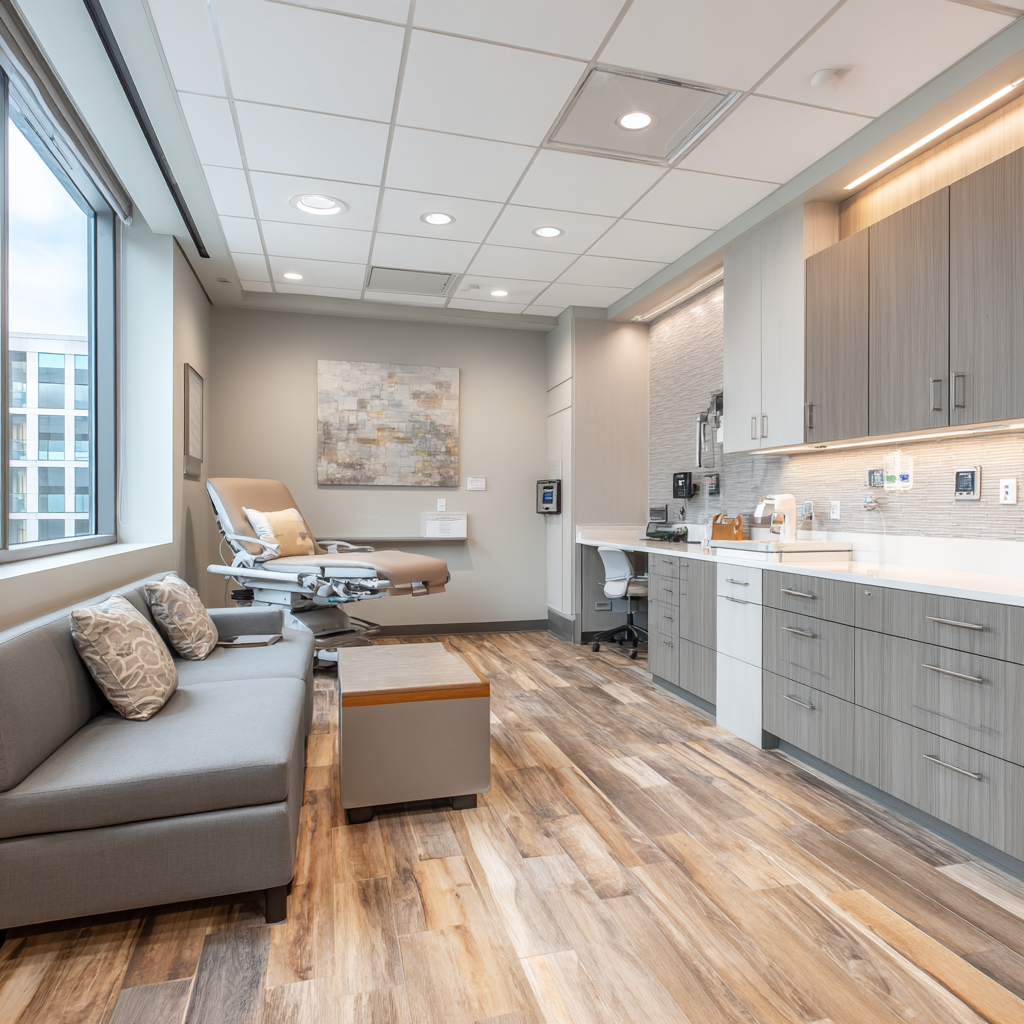

Medical office buildouts in the New York and New Jersey market are routinely underestimated—especially by teams coming from traditional commercial interiors. On paper, these projects can look like standard office fit-outs. In reality, they operate under a completely different set of constraints driven by regulatory oversight, infrastructure limitations, and landlord control that doesn’t always align with healthcare use.
The complexity rarely shows up at the beginning—and that’s exactly why it creates problems later. It surfaces during approvals, coordination, and construction, when decisions that seemed straightforward start conflicting with real-world conditions. The difference between projects that move efficiently and those that stall usually comes down to whether that complexity was anticipated early or discovered midstream.
Approvals Don’t Break Inside Agencies—They Break Between Them
One of the most common misconceptions is that approvals will follow a predictable sequence. In the NY/NJ market, that assumption doesn’t hold—particularly for medical tenants.
Projects often require review from multiple entities, including local building departments, health departments, and in some cases state agencies. These reviews don’t happen in sequence—and more importantly, they don’t align.
Projects don’t typically stall inside a single agency. They stall in the gaps between them. Requirements overlap, interpretations differ, and comments evolve as drawings develop. Something as straightforward as room classification or corridor layout can trigger additional rounds of review depending on how the use is interpreted.
Teams that move efficiently don’t wait for alignment to happen—they force it early. Engaging Authorities Having Jurisdiction (AHJs) before documents are fully developed helps clarify expectations and reduces late-stage revisions. Without that, approvals become a cycle of submission, comment, and rework that quietly erodes both schedule and budget.
MEP Coordination Is Where Projects Start to Break
Mechanical, electrical, and plumbing systems drive far more of these projects than most teams expect. Healthcare environments place demands on infrastructure that typical commercial buildings were never designed to support.
Electrical loads, ventilation requirements, and plumbing needs—especially when tied to diagnostic equipment or procedures—quickly exceed base building capacity. The issue isn’t just the requirement itself. It’s reconciling that requirement with what the building can realistically accommodate.
This is where projects start to break. Equipment dictates infrastructure, but infrastructure is constrained by the building. If that relationship isn’t resolved early, it leads to redesign, change orders, and delays once construction is already in motion.
We regularly see imaging equipment or specialized systems require upgrades that extend beyond the tenant space—into risers, roof equipment, or shared systems. At that point, the project is no longer just a fit-out. It becomes a building-level coordination effort, and timelines adjust accordingly.
Effective MEP planning isn’t about reacting to equipment requirements—it’s about understanding building capacity early and designing within it.
Landlord Constraints Will Override the Design If You Let Them
In most NY/NJ buildings, the landlord has more control over the project than the plan set suggests. These constraints don’t typically show up during early space planning—they show up when you try to implement the design.
Work hour restrictions, delivery limitations, and rules around modifying base building systems all shape how the project can actually be built. Structural conditions, ceiling heights, and existing infrastructure further narrow what’s feasible.
Any work that touches base building systems—electrical, HVAC, plumbing—requires landlord review. That process introduces another layer of coordination, and it doesn’t always move on the project’s timeline.
If the landlord isn’t treated as a core stakeholder from day one, the project will feel it later. Layouts that work on paper can become unworkable once building constraints are applied. By that point, redesign is no longer efficient—it’s reactive.
The projects that stay on track are the ones that engage ownership early, align on limitations, and design within those boundaries from the start.
Infrastructure Upgrades Are Not the Exception
Medical tenants almost always require more from a building than it was originally designed to provide. Increased electrical capacity, dedicated HVAC systems, upgraded plumbing, and enhanced life safety features are not edge cases—they’re typical conditions.
What’s often underestimated is how far those upgrades extend. They rarely stay within the tenant space. They impact shared systems, require landlord coordination, and in some cases affect other tenants.
This is where scope expands quietly. A project that starts as a tenant fit-out can evolve into a broader building-level intervention. If that possibility isn’t accounted for early, it shows up later as cost escalation and schedule pressure.
Understanding what the building can support—and where it can’t—is the starting point for every medical project. Without that, the project is effectively being designed in the dark.
Coordination Gaps Are Where Projects Actually Fail
Medical office buildouts involve multiple stakeholders—providers, designers, engineers, landlords, and contractors—each with different priorities. The failure point is rarely a major decision. It’s the accumulation of smaller coordination gaps that aren’t addressed early.
A misalignment between equipment requirements and electrical capacity. A layout that doesn’t fully account for code interpretation. A system that conflicts with base building limitations. None of these issues are catastrophic on their own—but together, they create friction that compounds as the project progresses.
By the time these conflicts surface during construction, options are limited and changes are expensive. That’s when projects slow down.
Early coordination isn’t about adding process—it’s about removing uncertainty. Aligning infrastructure, code requirements, and operational needs early prevents the kind of downstream issues that are difficult to recover from.
Design Only Works If It Can Be Built
The difference between a smooth project and a difficult one is rarely the design concept. It’s whether that design was developed with a clear understanding of how it would be executed within the constraints of the building and the market.
In the NY/NJ region, those constraints are the baseline. Approvals are layered, infrastructure is limited, and landlord control adds a level of complexity that doesn’t exist in standalone facilities.
Projects that acknowledge this early—treating approvals, MEP coordination, and landlord constraints as core drivers—tend to move efficiently.
Projects that don’t usually arrive at the same conclusion mid-construction: in this market, complexity isn’t something you manage later. It’s something you design around from the start.