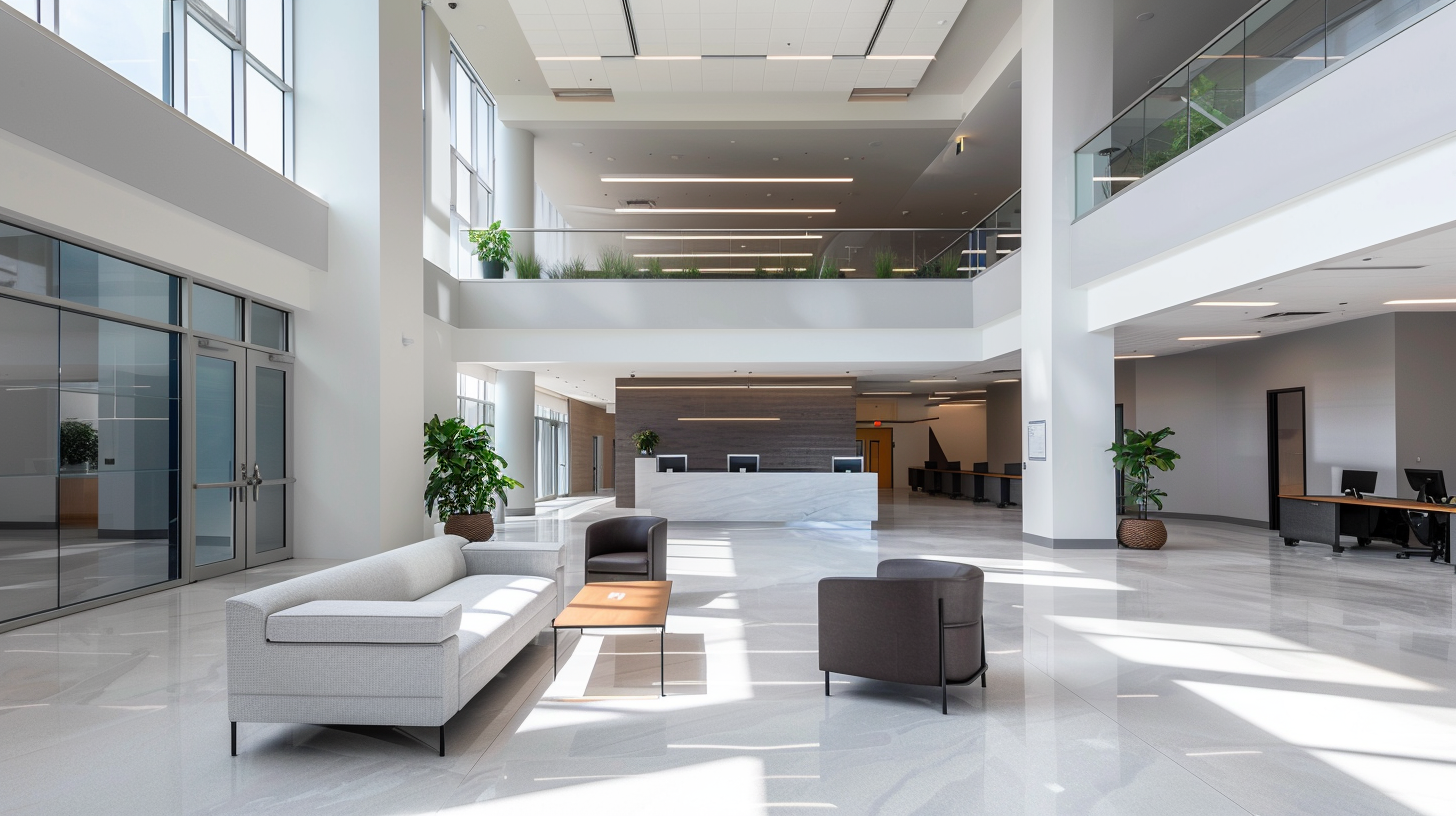
In the high-stakes real estate landscape of Manhattan and the surrounding Tri-State area, the aesthetic of the “modern office” has been defined by transparency, natural light, and expansive views. From the Hudson Yards to the revitalized corridors of Staten Island, glass-walled offices and open-plan configurations are the architectural standard. However, as many C-Suite executives have discovered shortly after move-in, there is a stark disconnect between visual transparency and acoustic privacy.
The very materials that convey a sense of prestige and openness—glass, polished concrete, and exposed steel—are the primary culprits of acoustic failure. In these environments, sound waves act like billiard balls, ricocheting off hard surfaces and creating a chaotic “cocktail party effect” that destroys focus and compromises sensitive board-room discussions. For the corporate leader, this isn’t just a design flaw; it is a productivity drain. Research indicates that poor acoustics is the #1 complaint in open offices, with the potential to reduce employee productivity by up to 66%.
As a Commercial Design Strategist, I have seen multimillion-dollar build-outs fail because acoustics were treated as an afterthought. This article serves as a technical roadmap for correcting these issues, ensuring your workspace supports both high-design aesthetics and the functional requirements of executive-level speech privacy.
The Glass Office Paradox
The “Glass Office Paradox” is the conflict between the desire for an egalitarian, light-filled workspace and the biological need for acoustic sanctuary. Glass is a non-porous, rigid material with a Noise Reduction Coefficient (NRC) near zero. While it serves as an excellent physical barrier, it is a catastrophic acoustic reflector.
In a typical NYC corporate suite, glass partitions create what we term the “fishbowl effect.” While employees can see their colleagues, the lack of sound containment means that conversations from a private office bleed into the workstations, and vice versa. This lack of speech privacy is a liability in sectors like finance, law, and healthcare, where confidentiality is non-negotiable. Furthermore, the reverberation time (the time it takes for a sound to decay) in a glass-heavy room is often double the recommended threshold for speech intelligibility, leading to “listener fatigue” during long Zoom calls or strategy sessions.
To solve this, we must look past the glass and address the entire volume of the space. Achieving acoustic balance requires a nuanced understanding of how sound behaves in a three-dimensional environment. We don’t necessarily need to remove the glass; we need to neutralize its reflective impact.
The ABCs of Acoustics: Absorb, Block, Cover
In technical acoustics, we utilize the “ABC” framework to categorize office acoustics solutions glass walls. For an executive-grade environment, all three elements must work in tandem.
A is for Absorption
Absorption refers to the use of soft, porous materials that “soak up” sound waves rather than reflecting them. This is measured by the Noise Reduction Coefficient (NRC), a scale from 0 to 1. A material with an NRC of 0.85 absorbs 85% of the sound that hits it. In a glass-walled office, we must introduce high-NRC materials on the remaining surfaces—primarily the ceiling and walls—to compensate for the glass’s 0.05 rating.
B is for Blocking
Blocking involves creating a physical barrier to stop sound from traveling between spaces. This is measured by Sound Transmission Class (STC). While glass is a “blocker,” its effectiveness depends on its thickness and lamination. Single-pane tempered glass often has an STC of 30-35, which allows loud speech to be understood in the next room. For C-suite privacy, we aim for an STC of 45 or higher, often requiring double-glazed glass systems with an air gap or specialized acoustic interlayers.
C is for Covering
Covering, or sound masking, is the most misunderstood yet effective tool in the NYC office. It involves adding a low-level, unobtrusive background sound to a space. By raising the “noise floor” of the office, we can effectively mask the intelligibility of distant conversations. It is the digital equivalent of a privacy screen for your ears.
Ceiling Solutions: Baffles and Clouds
The ceiling is the largest unobstructed surface in any office, making it the most critical area for acoustic intervention. In modern “industrial chic” offices where the plenum is exposed, sound bounces off the structural slab and travels over the tops of glass partitions.
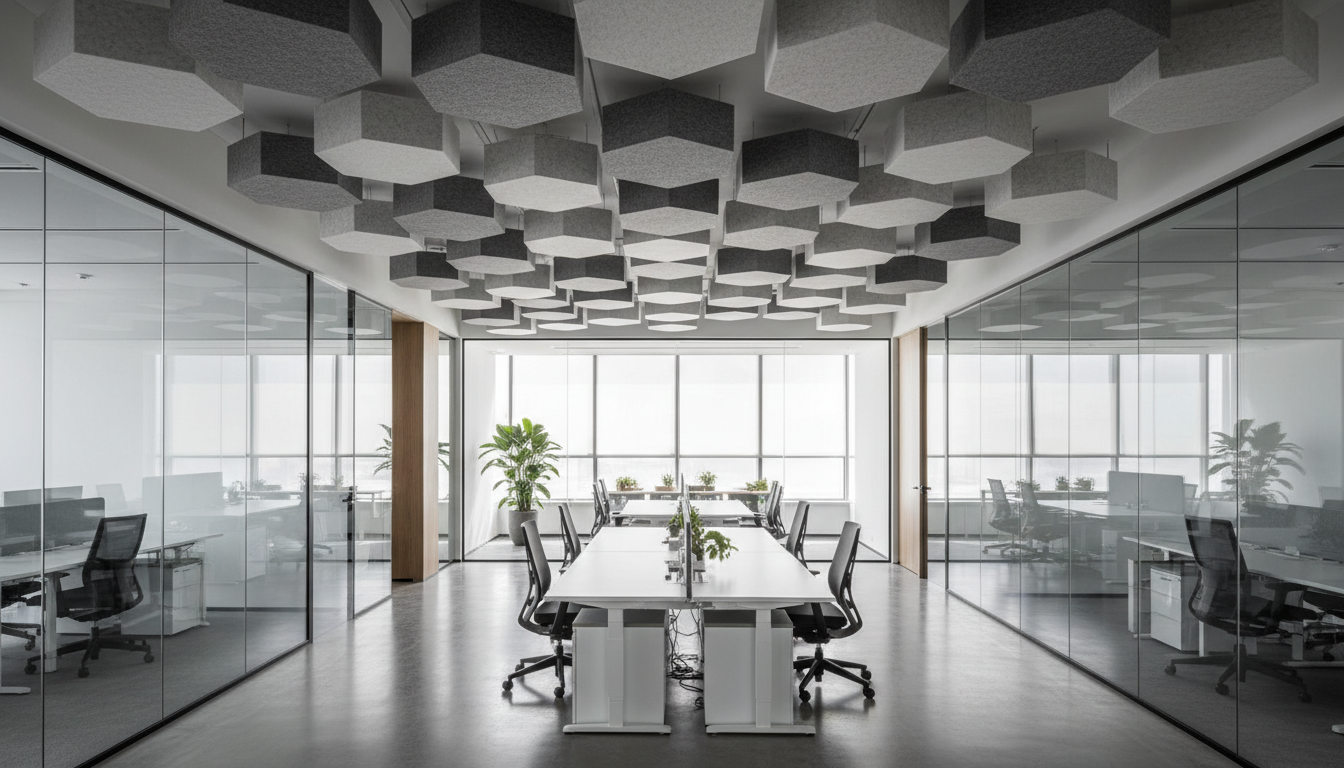
Acoustic Baffles: These are vertical panels suspended from the ceiling. Because they expose both sides of the material to the sound waves, they are highly efficient at breaking up reflections. PET felt baffles (made from recycled plastics) are the current industry standard, offering NRC ratings between 0.85 and 0.95. They can be arranged in geometric patterns that complement lighting fixtures, maintaining a high-design aesthetic while drastically lowering the reverberation time.
Acoustic Clouds: For conference rooms or areas directly above workstations, horizontal “clouds” are used. These act as a secondary ceiling, catching upward-traveling sound before it can hit the hard deck above. When designing for the Tri-State area’s premium office towers, we often integrate bespoke acoustic clouds that incorporate LED linear lighting, blending utility with luxury finishes.
Flooring and Wall Treatments
While the ceiling does the heavy lifting, the “eye-level” acoustics are managed through flooring and vertical wall treatments. In a glass-walled environment, we have limited wall real estate, which makes every square inch of the remaining drywall or columns vital.
- Strategic Rug Placement: While polished concrete is a favorite in NYC design, it is an acoustic nightmare. Utilizing high-pile area rugs in breakout zones or under conference tables can dampen “slap echo.”
- Acoustic Wall Panels: In rooms where glass occupies two or three walls, the remaining solid wall should be treated with high-performance panels. Fabric-wrapped fiberglass or sculpted PET panels can be customized to match corporate branding or serve as an architectural feature.
- Acoustic Drapery: For floor-to-ceiling glass perimeters, heavy acoustic curtains provide a dual benefit. They offer solar control and can be closed during sensitive meetings to provide an additional layer of sound absorption. Specialized acoustic sheers now exist that maintain some transparency while offering an NRC of 0.60.
| Material | NRC Rating (Absorption) | Best Use Case |
|---|---|---|
| PET Felt Baffles | 0.85 – 0.95 | Open ceilings / workstations |
| Glass Partition | 0.05 | Visual connectivity |
| Acoustic Wall Panels | 0.80 | Conference rooms / Zoom rooms |
Sound Masking Technology
In a quiet, glass-heavy office, every pin drop is amplified. This is known as the “library effect.” To combat this, sound masking technology is the gold standard for NYC corporate environments. Unlike a common white noise machine, professional sound masking systems use a network of small emitters (speakers) installed in or above the ceiling.
The system emits a scientifically engineered spectrum of sound that mimics the frequencies of human speech. By doing so, it makes speech less intelligible over a distance. For an executive, this means that while people can tell you are talking in your office, they cannot decipher *what* you are saying. This is the ultimate solution for achieving speech privacy in open-plan layouts where physical barriers are insufficient.
The ROI on sound masking is significant. It reduces the need for expensive, ultra-high STC glass retrofits and allows for a more flexible, open floor plan without sacrificing the ability to focus. For firms looking to optimize their Corporate Office Design in Staten Island, NY or Manhattan, sound masking is often the missing piece of the puzzle.
Key Takeaways for the C-Suite
- Understanding NRC vs. STC: Use high-NRC materials to stop echoes within a room; use high-STC materials (like double-glazed glass) to stop sound from moving between rooms.
- Strategic Placement: You don’t need to cover every surface. Strategic placement of soft surfaces (rugs, curtains, and baffles) at the points of first reflection can solve 80% of issues.
- Sound Masking ROI: Electronic sound masking is often the most cost-effective way to ensure speech privacy in high-density NYC offices.
Frequently Asked Questions
Q: How do you reduce echo in a glass office?
A: Add absorptive materials like ceiling baffles, acoustic lighting, or heavy drapery to counter hard surfaces. The goal is to provide a “soft” surface for sound waves to land on instead of bouncing back into the room.
Q: Is double-paned glass worth the investment?
A: For executive boardrooms and HR offices, yes. The air gap between panes significantly improves the STC rating, ensuring that sensitive conversations remain within the room.
Q: Can we fix acoustics without ruining the office aesthetic?
A: Absolutely. Modern office acoustics solutions glass walls are designed to be architectural features. From felt “leaves” to textured wall art, acoustic treatments can enhance the design rather than hide it.
In conclusion, the goal of a modern office is to facilitate collaboration without sacrificing the cognitive health of the employees. By implementing a technical, three-pronged approach—Absorb, Block, and Cover—executives can ensure their glass-walled spaces are as functional as they are beautiful. At the intersection of high-design aesthetics and technical performance lies a workspace that truly empowers its people.
Ready to transform your workspace?
Assess Your Office Acoustics with our expert team today.