The Inclusive Classroom Model: Beyond One-Size-Fits-All
As educational leaders and school board administrators, you are tasked with a profound responsibility: creating an environment where every child who walks through your doors has an equitable opportunity to succeed. For decades, the standard classroom was designed for a “typical” student—a theoretical average that rarely exists in reality. Today, we recognize that our student populations are beautifully diverse, particularly in how their brains process information. This recognition is the foundation of neurodiverse classroom design.
Neurodiversity is the concept that neurological differences, such as ADHD, Autism, and Dyslexia, are natural variations in the human genome rather than deficits that need to be “fixed.” When we design through a lens of compassion and humanism, we move away from asking how a student can fit into a room, and instead ask how a room can support the student. This shift is not merely an aesthetic choice; it is a commitment to Universal Design for Learning (UDL). Research indicates that schools implementing UDL principles see a marked improvement in student engagement and a significant reduction in behavioral incidents, as the environment itself mitigates the stressors that lead to dysregulation.
In our work as commercial design strategists, we have seen how thoughtful physical changes can transform the educational experience. For instance, when looking at High School Design in Long Island, NY, the integration of flexible zones has allowed students to self-regulate, leading to higher academic performance and a more harmonious school culture. By prioritizing inclusive design, we aren’t just building classrooms; we are building sanctuaries for learning.
Zoning for Different Learning Styles
The traditional “rows of desks” layout assumes that every student learns best while seated and facing forward. However, for a student with ADHD or sensory processing sensitivities, this rigid structure can be a barrier. Effective neurodiverse classroom design utilizes “zoning” to create a landscape of options within a single room.
The Importance of ‘Retreat Spaces’
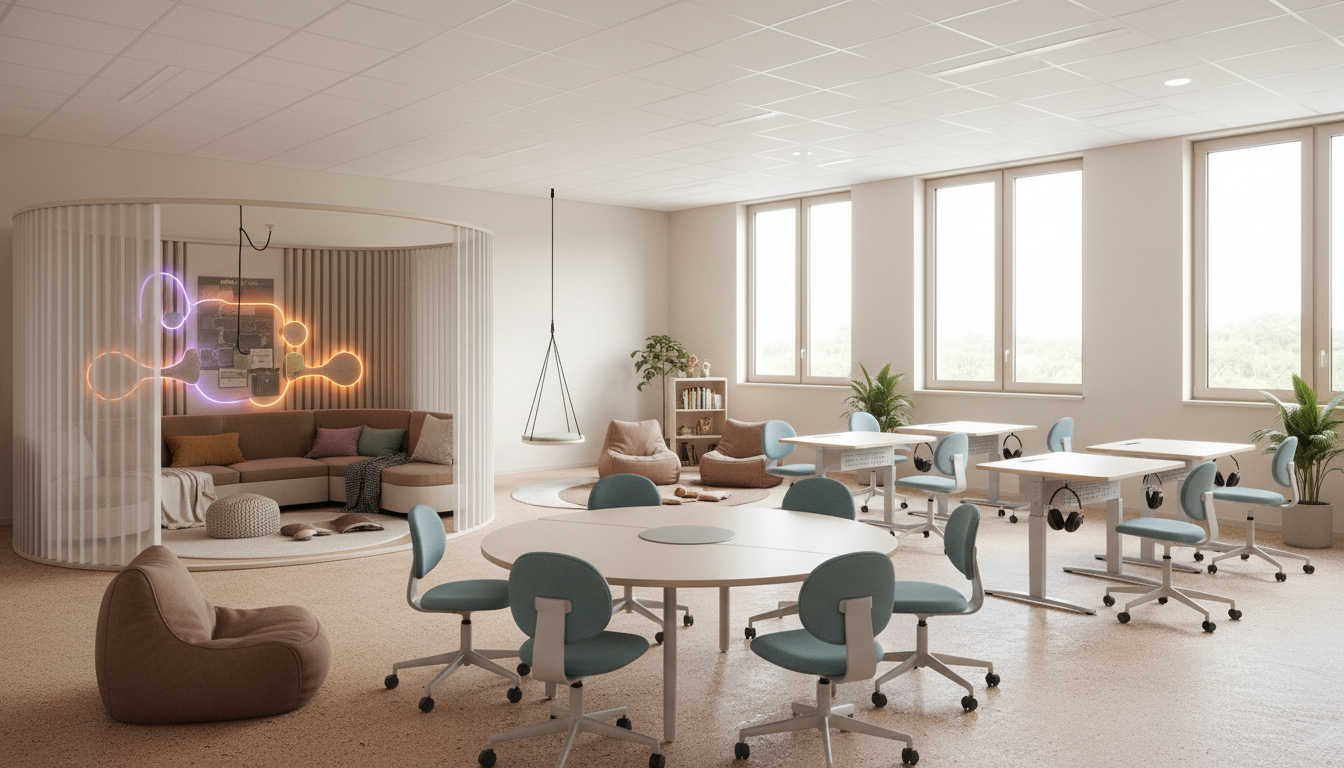
One of the most critical elements of an inclusive classroom is the “quiet corner” or “retreat space.” For an autistic student experiencing sensory overload, the ability to step away from the social and sensory “noise” of a classroom is essential. These are not “time-out” areas for punishment; rather, they are “time-in” spaces for deregulation. These zones should be tucked away from high-traffic areas, perhaps shielded by a low bookshelf or an acoustic screen, and equipped with soft seating and noise-canceling headphones. Providing a student with the agency to manage their own sensory needs fosters independence and emotional intelligence.
High-Energy vs. Low-Energy Zones
Conversely, some students—particularly those with ADHD—require movement to think. Creating a high-energy zone with standing desks or “fidget” stations allows these students to channel kinetic energy without disrupting their peers. By intentional zoning, we acknowledge that different tasks and different temperaments require different atmospheres. A collaborative “campfire” zone for group work can exist alongside a “cave” zone for deep, individual focus. This variety ensures that the environment works for the child, rather than the child working against the environment.
Sensory Considerations: Light and Sound
For many neurodivergent individuals, the world is turned up to a “10” at all times. The hum of a refrigerator, the flicker of a fluorescent light, or the texture of a carpet can be physically painful or incredibly distracting. As administrators, addressing these sensory “micro-stressors” is one of the most cost-effective ways to improve learning outcomes.
Acoustic Treatments to Aid Auditory Processing
Acoustics are often overlooked in school design, yet they are vital for students with Dyslexia or Auditory Processing Disorder. High ceilings and hard surfaces create echoes that scramble speech sounds, making it exhausting for students to follow a teacher’s instructions. By incorporating acoustic ceiling tiles, wall-mounted felt panels, or even area rugs, we can dampen the “reverberation” of the room. This clarity of sound reduces the cognitive load on students, allowing them to focus on the content of the lesson rather than the effort of hearing it.
The Power of Lighting
Lighting is another primary factor in sensory regulation. Standard fluorescent lighting often has a subtle flicker and a high-pitched hum that can be agonizing for students on the autism spectrum. Moving toward dimmable LED lighting that mimics natural daylight can dramatically reduce headaches and anxiety. Furthermore, the use of adjustable lighting allows teachers to signal transitions—dimming the lights can indicate a shift from high-energy activity to a quiet reading period, providing a visual cue that helps students transition more smoothly between tasks.
Furniture Flexibility: Supporting the Body to Support the Mind
The relationship between the body and the mind is profound. Many neurodivergent students struggle with proprioception—the sense of where their body is in space. Without the right physical support, these students may feel “groundless,” leading to fidgeting and an inability to concentrate. This is where furniture flexibility becomes a cornerstone of neurodiverse classroom design.
Instead of uniform plastic chairs, consider a menu of seating options. Wobble stools and rocking chairs provide the “vestibular input” that many ADHD students crave, allowing them to move their bodies while keeping their minds engaged with the lesson. Standing desks offer an alternative for those who find sitting for long periods to be a physical strain. When we offer choice, we empower students to discover how they learn best. This is the heart of the compassionate humanist approach: treating students as partners in their own education, capable of making choices that support their well-being.
| Student Need | Design Solution | Benefit |
|---|---|---|
| ADHD / Kinetic | Wobble stools / Standing desks | Channels excess energy and improves focus. |
| Sensory Sensitive | Dimmable lighting / Quiet nooks | Reduces sensory overwhelm and prevents burnout. |
| Visual Processing | Decluttered walls / Color coding | Improves focus and aids in navigation/organization. |
Wayfinding and Visual Cues
For students with Dyslexia or executive functioning challenges, a school can feel like a labyrinth. Organization and navigation (often called “wayfinding”) are essential components of an inclusive environment. If a student is constantly worried about where they are supposed to be or how to find their materials, they have less mental energy available for learning.
Using Color for Function, Not Just Decoration
Color psychology plays a vital role here. Rather than using bright, primary colors that can be overstimulating, designers are moving toward “muted palettes” with strategic pops of color for wayfinding. For example, the math wing might be coded in a calming blue, while the science wing is a soft green. This use of color helps students orient themselves within the building without the need for complex signage. Inside the classroom, color-coded bins and shelves can help students with ADHD or Dyslexia organize their belongings and find supplies independently, reducing the “friction” of the school day.
The Visual Field: Less is More
In many classrooms, every square inch of wall space is covered with posters, calendars, and student work. For a student with visual processing issues, this is “visual noise” that can make it impossible to focus on the teacher. A more inclusive approach involves “decluttering the visual field.” By keeping the front of the classroom (the focal wall) clear of distractions and using closed storage to hide cluttered supplies, we create a calm visual environment. Displaying student work is important for belonging, but it can be done in a dedicated “gallery” zone rather than scattered throughout the room.
A Strategic Investment in Human Potential
As administrators, you have many competing priorities, from budget constraints to standardized testing goals. It is important to recognize that neurodiverse classroom design is not a luxury; it is a strategic investment in the success of your entire school community. When we design for the edges—the students with the most significant needs—we end up creating an environment that is better for everyone. A quiet corner is used by the student who is grieving; a wobble stool is used by the student who just needs a little extra movement on a rainy day; clear wayfinding helps the new student who is nervous on their first day.
By creating educational environments that function for every student, we send a powerful message of inclusion and respect. We tell our students that they don’t have to change who they are to be successful; rather, we are committed to building a world that values them exactly as they are.
Frequently Asked Questions
Q: Why is flexible seating important?
A: It allows students to choose the posture that helps them focus best, accommodating different proprioceptive and vestibular needs. This autonomy leads to better self-regulation and academic engagement.
Q: Is neurodiverse design more expensive than traditional design?
A: Not necessarily. Many improvements, such as decluttering walls, changing furniture layouts, or using color-coding, require minimal investment. When major renovations occur, choosing dimmable lighting or acoustic treatments provides a high ROI by reducing behavioral incidents and teacher burnout.
At DIG Interior Design, our mission is to translate these human needs into functional, beautiful educational spaces. We believe that every school board has the power to change a child’s life through the power of design.
Modernize Your School
Ready to create a truly inclusive learning environment for your students? Our team of educational design experts is here to help you navigate the transition to neurodiverse-friendly spaces.
DIG Interior Design has completed sensory-inclusive learning environments across the Northeast. Browse our Education Project Portfolio to see real examples of inclusive classrooms and ABA therapy spaces, or contact our team to discuss your school project.
Key Standards, Research & Organizations in Neurodiverse Classroom Design
- IDEA (Individuals with Disabilities Education Act) — federal law requiring schools to provide Free Appropriate Public Education (FAPE) in the Least Restrictive Environment (LRE); the physical design of classrooms is increasingly interpreted as part of LRE compliance.
- Section 504 (Rehabilitation Act of 1973) — prohibits discrimination against students with disabilities in programs receiving federal funding, creating a legal basis for environmental accommodations including design modifications.
- ANSI/ASHRAE Standard 55 & WELL Building Standard — thermal comfort and indoor environment quality standards applicable to school design; the WELL Education concept specifically addresses neurodiversity.
- Magda Mostafa (American University in Cairo) — architect and researcher who developed the Autism ASPECTSS Design Index, a peer-reviewed framework for designing environments for autistic students covering acoustics, spatial sequencing, escape spaces, and sensory zoning.
- CDC / NCBDDD — the CDC reports that 1 in 36 children in the U.S. is identified with autism spectrum disorder (2023 data), underscoring the scale of demand for inclusive learning environments.
- CAST (Center for Applied Special Technology) — developers of Universal Design for Learning (UDL) framework, the evidence-based educational approach that underpins neurodiverse classroom design philosophy.
The design research supporting neurodiverse classroom environments is growing rapidly. A study published in Building and Environment found that acoustic interventions in classrooms reduced off-task behavior in students with ADHD by up to 25%. The UK Design Council’s research on inclusive school design documents consistent improvements in academic performance and reduced behavioral incidents when sensory-informed design principles are applied. For school administrators, architects of record, and facility planners in New York and New Jersey, DIG Interior Design offers a full educational design service — from programming and code compliance through construction administration and FF&E procurement — purpose-built for inclusive, neurodiverse-ready learning environments.
Frequently Asked Questions: Neurodiverse Classroom Design
What is neurodiverse classroom design?
Neurodiverse classroom design creates learning environments that support students with ADHD, autism, dyslexia, and sensory processing differences alongside neurotypical peers. Key features include flexible seating options, acoustic zoning, low-stimulation color palettes, sensory break spaces, and adjustable lighting — all designed to reduce cognitive overload and improve focus for the full spectrum of learners.
How does classroom design affect students with ADHD?
Students with ADHD benefit significantly from classrooms that offer movement opportunities (standing desks, wobble stools, flexible seating zones), reduce visual clutter, use natural light with daylight-adjustable fixtures, and provide acoustic privacy to minimize distraction. Research shows that well-designed classrooms can reduce ADHD symptom severity and improve on-task time by up to 25% compared to standard environments.
What colors are best for neurodiverse classrooms?
Neurodiverse classrooms perform best with muted, low-saturation color palettes — soft blues, greens, and warm neutrals — rather than bright primaries. High-contrast or visually “busy” patterns on walls, ceilings, and floors increase cognitive load for students with sensory sensitivities. Color should be used strategically to define zones (calm corners, active areas, direct instruction spaces) rather than applied uniformly across surfaces.
What is a sensory break room in a school?
A sensory break room (or sensory retreat) is a designated low-stimulation space within a school where students experiencing sensory overload can decompress without leaving the building. Effective sensory rooms feature dimmable lighting, acoustic dampening, minimal visual clutter, calming colors, and sometimes tactile elements like weighted blankets or textured wall panels. They are distinct from timeout spaces — the goal is regulation, not punishment.
How do you reduce noise in a neurodiverse classroom?
Acoustic management in neurodiverse classrooms includes ceiling baffles or acoustic tiles, upholstered furniture, carpet or cork flooring, soft wall panels, and strategic room layout that separates high-activity zones from quiet learning areas. Sound masking systems can also be installed to create consistent ambient sound that reduces distraction from unpredictable noise spikes.
Does ADA require schools to accommodate neurodiverse students through design?
While the ADA primarily addresses physical access, Section 504 of the Rehabilitation Act and IDEA (Individuals with Disabilities Education Act) require schools to provide appropriate learning environments for students with qualifying disabilities — including those with autism and ADHD. Thoughtful physical design is increasingly recognized as a component of FAPE (Free Appropriate Public Education) compliance, particularly in new construction and major renovations.
How much does a neurodiverse classroom redesign cost?
A full neurodiverse classroom renovation typically costs $15,000–$60,000 per room depending on scope, existing conditions, and whether acoustic upgrades and lighting retrofits are included. School-wide inclusive design programs can be phased strategically to spread investment across budget cycles. Early engagement of a design team familiar with inclusive educational environments reduces costly change orders and ensures regulatory compliance.