
“`html
By: Senior Living Advocate | Dementia Care Design
To walk through the halls of a memory care community is to navigate a world that is gradually becoming unfamiliar. For a resident living with Alzheimer’s or related dementias, the environment is no longer a passive backdrop to life; it is a complex puzzle that can either offer comfort or induce profound anxiety. As senior living operators and developers, our mission transcends providing a roof and medical care. We are the architects of autonomy. By implementing thoughtful memory care wayfinding strategies, we can restore a sense of agency to those who feel the world slipping away.
Wayfinding is often mistaken for simple signage. In a traditional office building, a sign saying “Restroom” or “Exit” suffices. However, in the context of cognitive decline, the brain’s ability to process abstract symbols and text diminishes. The “Compassionate Humanist” approach to design recognizes that true wayfinding is intuitive, sensory, and deeply rooted in the resident’s remaining cognitive strengths. When we design with empathy, we don’t just build hallways; we build pathways to dignity.
Understanding Dementia Perception
To design effectively, we must first understand the physiological changes occurring in the resident. Dementia does more than affect memory; it fundamentally alters sensory perception. Many residents experience a narrowing of their visual field—often referred to as “binocular vision”—where peripheral awareness is lost, making it difficult to scan a room for cues. Furthermore, depth perception becomes unreliable, and the ability to distinguish between similar colors fades.
This “perceptual thinning” means that a resident may not see a white door on a white wall, or they may perceive a dark-colored rug as a gaping hole in the floor. Understanding these shifts is the cornerstone of memory care wayfinding strategies. When we recognize that a resident is navigating a world that lacks contrast and clarity, our design choices shift from aesthetic preferences to essential clinical interventions. Research shows that proper wayfinding design can reduce resident agitation and wandering-related anxiety by up to 40%. By minimizing the cognitive load required to move from point A to point B, we preserve the resident’s energy for meaningful social engagement and self-care.
The Role of Visual Cues
In memory care, the environment must “speak” to the resident without using words. We utilize what designers call “decision points”—intersections or junctions where a resident must choose a direction. Without a clear cue, these points become sources of frustration and “looping” behavior, where a resident walks in circles, increasingly distressed.
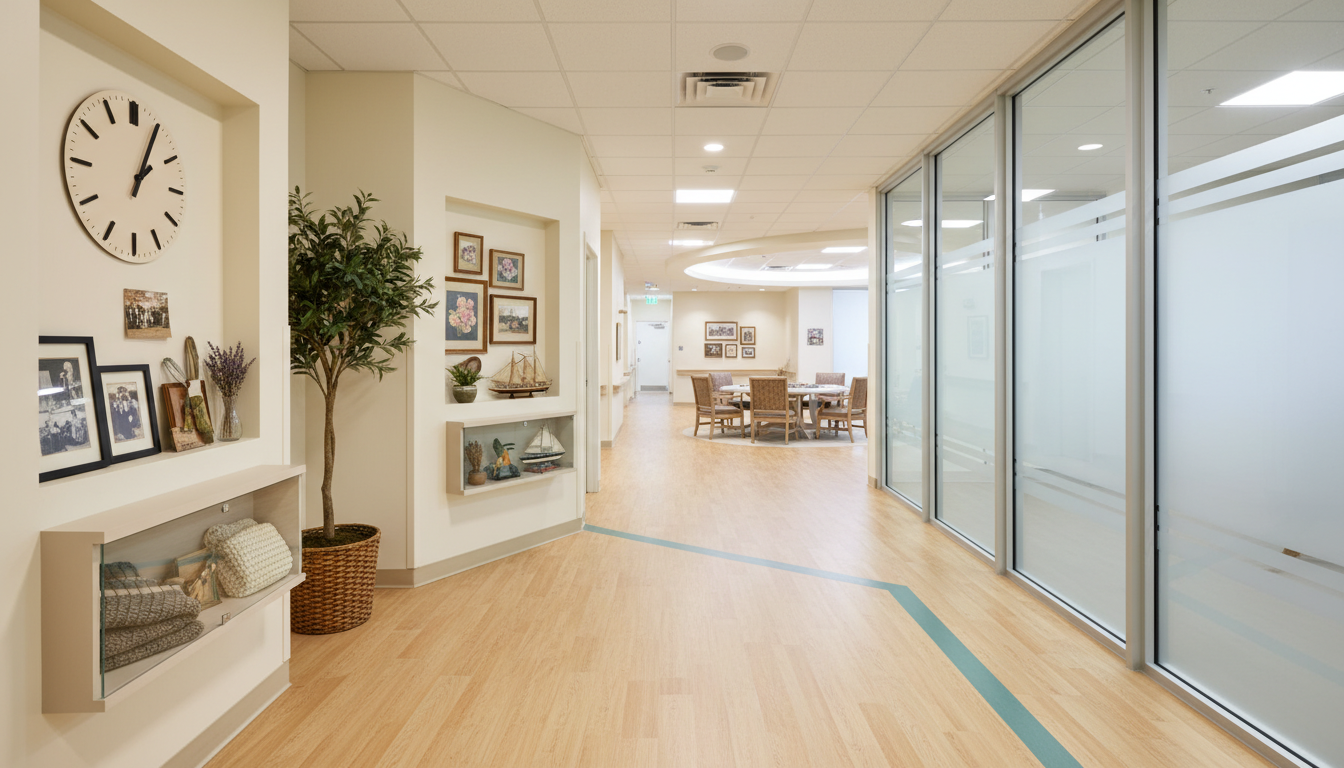
Instead of relying on text-heavy signs, we use landmarks. A landmark is a high-salience visual anchor that is easily recognizable and memorable. For example, placing a vibrant, tactile piece of art or a large, ticking grandfather clock at a hallway junction provides an immediate “you are here” marker. These landmarks serve as cognitive North Stars. If a resident knows that their room is “past the aquarium,” they can navigate with a level of independence that a “Wing B” sign could never provide.
Furthermore, the layout of the community itself plays a vital role. Modern Senior Living Design in White Plains, NY, and across the country is moving away from long, institutional corridors with dead ends. Dead ends are “anxiety traps” for those with dementia. When a resident hits a wall with no clear path forward, it can trigger a catastrophic reaction. Instead, we design looped paths. A continuous, circular walking path allows for “purposeful wandering,” ensuring that the resident always eventually returns to a familiar common area without the stress of being “lost.”
| Design Element | Purpose | Example |
|---|---|---|
| Memory Box | Room Recognition | Shadow box with personal photos |
| Landmarks | Orientation | Aquarium or Piano at intersections |
| High Contrast | Toilet Visibility | Black seat on white toilet |
Flooring and Fall Prevention
Flooring is perhaps the most misunderstood element of memory care design. While a developer might see a beautiful patterned carpet as a luxury touch, a resident with dementia might see a floor covered in snakes or stones. High-contrast patterns or busy floral designs can cause “visual noise,” leading the resident to hesitate, overstep, or lose their balance.
One of the most critical memory care wayfinding strategies involves the use of Light Reflectance Value (LRV). To the aging eye, objects with similar LRVs blend together. To ensure safety, there should be at least a 30-point difference in LRV between the floor and the wall. This “defines” the space, helping the resident understand where the floor ends and the wall begins.
We must also be wary of transitions. A dark threshold strip between a carpeted hallway and a tiled dining room can be perceived as a step or a trench. To a resident with compromised depth perception, this “visual cliff” is terrifying. The goal is to use monolithic flooring colors that provide a steady, predictable surface. However, we can use contrast to our advantage to discourage entry into unsafe areas. A dark-colored mat placed in front of an exit door or a service kitchen can act as a “virtual barrier,” as the resident will naturally avoid stepping into what looks like a void.
Circadian Lighting and Sleep
Lighting is a silent but powerful tool in wayfinding and behavioral management. Many residents suffer from “sundowning,” a state of increased confusion and agitation that occurs as daylight fades. This is often linked to a disruption in the circadian rhythm—the body’s internal clock.
Advanced memory care wayfinding strategies incorporate “tunable” or circadian lighting systems. These systems mimic the natural progression of the sun, providing bright, blue-enriched light in the morning to promote alertness and suppress melatonin, and shifting to soft, amber tones in the evening to encourage relaxation.
Beyond the biological impact, lighting directs the eye. Uniform, glare-free lighting is essential. Glare on a highly polished floor can be mistaken for water, causing a resident to slip or refuse to walk. Conversely, pooling light on a beautiful piece of furniture or a “memory box” creates a visual destination. By highlighting the path and the “prizes” along that path, we guide the resident’s journey through the day with light rather than commands.
Personalized Entryways
The transition from a public corridor to a private residence is a critical moment for a resident’s self-esteem. In many institutional settings, every door looks identical, leading to “room intrusion,” where residents accidentally enter the wrong apartment. This is not just a privacy issue; it is a significant source of conflict and anxiety among residents.
The “Memory Box” is a quintessential humanist design solution. By placing a recessed, glass-fronted shadow box next to each resident’s door, we provide a personalized “anchor.” This box doesn’t just hold “stuff”; it holds the resident’s identity. A retired pilot might have a model airplane and a photo of his crew; a grandmother might have a piece of her favorite knitting and a picture of her grandchildren.
This visual cue works because recognition of personal items often remains intact long after the ability to remember a room number has faded. Additionally, painting resident doors in distinct, high-contrast colors—different from the surrounding walls—makes the “target” clear. When a resident can identify their own home from twenty feet away, the relief is palpable. It reinforces the idea that they are not just a patient in a facility, but a person in their own home.
Designing with Empathy for Cognitive Decline
As operators and developers, we must ask ourselves: Does this space demand something from the resident, or does it give something back? Every design choice should be a gift of clarity. When we reduce the “noise” of the environment, we allow the person behind the diagnosis to emerge. Designing with empathy means acknowledging that while we cannot cure the disease, we can absolutely cure the environment of the obstacles that cause fear.
Our commitment at DIG Interior Design is to merge clinical necessity with human warmth. By focusing on memory care wayfinding strategies that prioritize the resident’s perspective, we create communities where seniors don’t just exist—they navigate their lives with dignity and grace.
Frequently Asked Questions
- Q: Why is flooring contrast important in dementia care?
A: Seniors with dementia may perceive high-contrast patterns as obstacles or holes, causing falls. Proper LRV contrast between the floor and wall, however, helps them define the boundaries of the room. - Q: How do “decision points” affect resident behavior?
A: Intersections without clear visual cues cause confusion and anxiety. By placing landmarks like art or furniture at these points, we help residents make independent choices about where to go next. - Q: Can lighting really reduce resident agitation?
A: Yes. Circadian lighting helps regulate sleep-wake cycles, which can significantly reduce “sundowning” symptoms and evening restlessness by signaling to the brain when it is time to rest.
Ready to transform your community into a haven of safety and navigation?
“`