
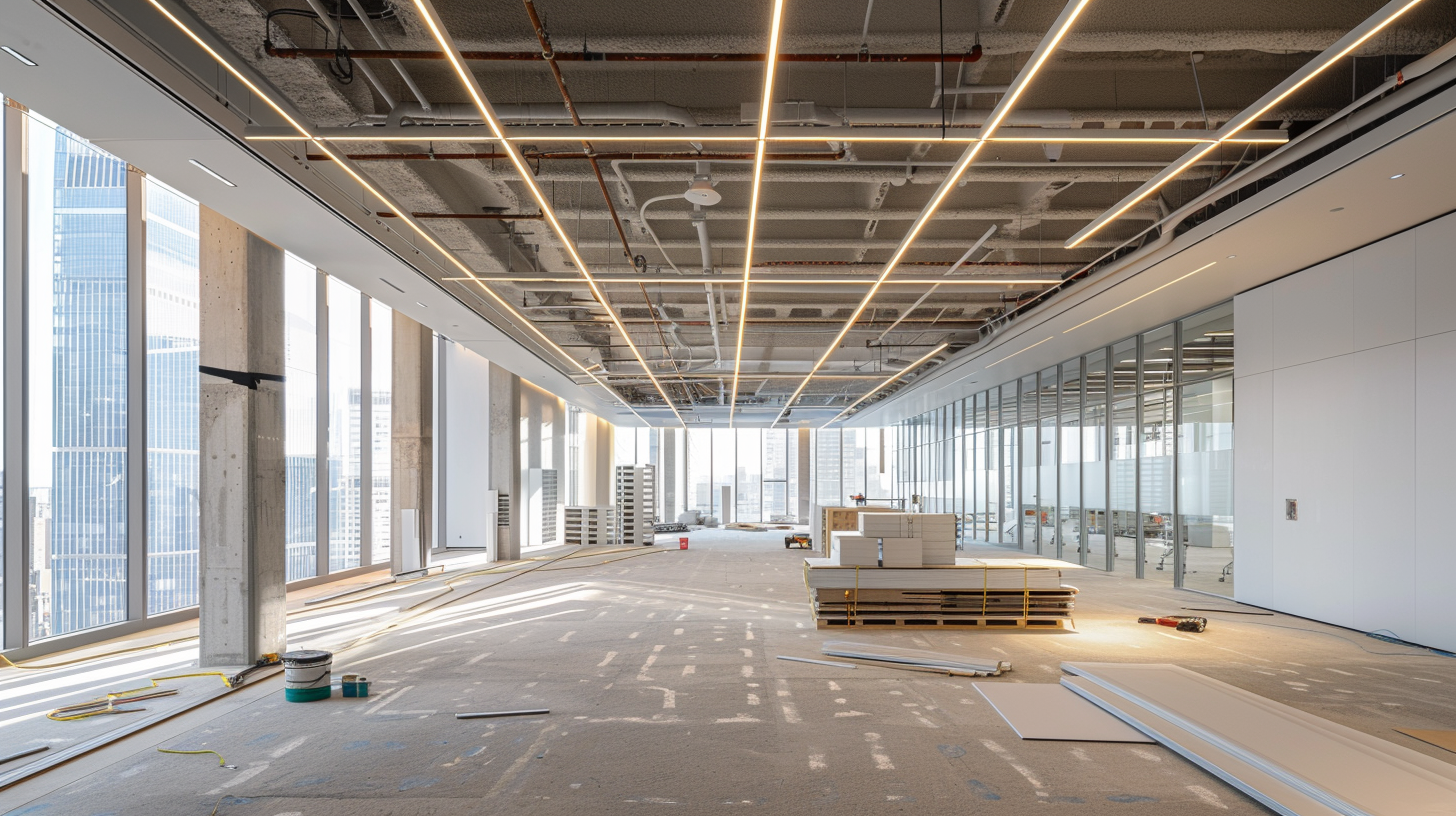
Office fit-outs in New York City rarely move as quickly as teams expect. Even relatively straightforward projects can encounter delays that extend schedules well beyond initial projections.
What slows these projects down is not usually one major issue. It’s the accumulation of constraints unique to the NYC market—building rules, trade coordination, approvals, logistics, and the realities of working inside occupied high-rise environments.
Projects that stay on track are not the ones that avoid complexity. They are the ones that anticipate where that complexity actually shows up.
Building Rules Shape the Construction Schedule
In NYC office buildings, construction is heavily influenced by landlord and property management requirements. These rules affect everything from work hours to material deliveries to elevator usage.
Where projects tend to slow down is in underestimating how restrictive these conditions can become once construction begins.
Freight elevator scheduling alone can significantly affect sequencing. Limited delivery windows, after-hours work requirements, and restrictions around noise-producing activities all compress the available construction schedule.
What looks achievable on paper often becomes more segmented in practice.
This is especially true in occupied buildings where disruption to existing tenants is tightly controlled. Construction teams are not just building the project—they are operating within the daily rhythm of the building itself.
Union Trade Coordination Adds Complexity
Union labor is a standard part of many NYC commercial projects, particularly in larger buildings and Class A office environments.
The challenge is not union labor itself. The challenge is coordination between trades operating under tight schedules and limited site access.
Mechanical, electrical, plumbing, millwork, flooring, and specialty trades all need to move through the project in sequence. When one scope slips, the impact carries downstream quickly.
This is where projects begin to lose momentum. Delays are rarely isolated—they compound as multiple trades compete for the same working windows and site access.
Well-coordinated projects account for this early. Poorly coordinated ones spend much of construction reacting to sequencing conflicts.
Approvals Rarely Move in a Straight Line
Permitting and approvals in NYC are often more iterative than teams expect. Even when documentation is strong, review cycles can introduce revisions, clarifications, and additional coordination.
Projects don’t usually stall on one major code issue. They slow down through accumulation:
– Minor drawing comments
– Incomplete coordination between disciplines
– Adjustments triggered by building conditions
– Clarifications requested during review
Each round adds time.
Where teams struggle is assuming approvals happen in a clean sequence. In reality, reviews overlap, evolve, and often require multiple disciplines to respond simultaneously.
Projects that move efficiently tend to resolve potential conflicts before submission rather than relying on the review process itself to surface them.
Existing Conditions Create Hidden Delays
Many office fit-outs occur within older buildings where existing conditions are not fully documented until construction is underway.
This is where hidden complexity emerges:
– Unmapped infrastructure
– Structural limitations
– Limited ceiling space
– Existing systems that conflict with new layouts
These issues are common, particularly in prewar or heavily modified buildings.
Once discovered, they require redesign and re-coordination across multiple trades. What initially appears to be a small adjustment often affects mechanical routing, lighting, ceiling systems, and schedule sequencing simultaneously.
Projects that plan for this uncertainty tend to absorb it more effectively than those operating on overly rigid timelines.
Logistics Are Often More Difficult Than Construction
In NYC, logistics can become more complicated than the physical build itself.
Material staging is limited. Access routes are constrained. Deliveries must often be coordinated around building operations, traffic patterns, and city restrictions.
This is where timelines quietly extend. Work that could happen continuously in another market becomes fragmented into tightly managed windows.
Even relatively simple activities—dumpster swaps, large deliveries, equipment movement—require coordination that consumes time and planning effort.
Ignoring these logistical realities early creates schedules that look efficient but are difficult to execute.
Late Design Changes Have Outsized Impact
Changes during construction affect every project, but in NYC office fit-outs, the impact is amplified by coordination and access constraints.
A late adjustment to layout or finishes may seem manageable on its own. In practice, it can trigger:
– Updated drawings
– Re-sequencing between trades
– Additional approvals
– New delivery coordination
Because projects already operate within compressed schedules, even small changes can create disproportionate delays.
The earlier key decisions are finalized, the more stable the project becomes operationally.
Coordination Determines Whether Schedules Hold
Most office fit-out delays are not caused by a single failure point. They happen when small coordination gaps accumulate across the project.
A missed trade handoff. An approval revision. An access conflict. A delivery delay.
Individually, these issues are manageable. Together, they begin to affect sequencing, labor availability, and momentum.
This is why coordination becomes the real schedule driver in NYC projects.
Teams that communicate early, align trades effectively, and anticipate operational constraints consistently outperform those that treat coordination as secondary.
Understanding the Real Drivers of Delay
Office fit-outs in NYC are not slowed down by one dramatic issue. They are slowed down by the realities of building and coordinating within one of the most constrained construction environments in the country.
Building rules, union trade sequencing, approvals, logistics, and existing conditions all shape how projects move.
The projects that stay on schedule are not necessarily simpler. They are better coordinated and more realistic about where time is actually lost.
Because in NYC, successful projects are not just designed well.
They are planned around reality.