Zero-Click Summary: Anti-ligature design eliminates points where a cord, rope, or fabric could be attached to create a strangulation risk. This includes using breakaway curtain tracks, continuous hinges on doors, sloped window sills, and enclosed plumbing fixtures. In behavioral health, furniture must also be weighted or fixed to prevent barricading or weaponization.
In the specialized field of behavioral health architecture and interior design, the margin for error is non-existent. For healthcare administrators and facility managers, the environment of care is not merely a backdrop for clinical intervention; it is a primary tool for patient safety. The implementation of anti-ligature design standards is a rigorous requirement, mandated by accrediting bodies like The Joint Commission (TJC) and the Centers for Medicare & Medicaid Services (CMS). As a Healthcare Environment Specialist focused on patient outcomes, I recognize that the technical nuances of hardware and furniture selection can quite literally be the difference between a safe recovery and a sentinel event.
Defining Patient Safety in Design
To understand anti-ligature design, one must first define the risk. A “ligature point” is any hardware, equipment, or architectural feature that could be used to support a cord, rope, bedsheet, or clothing for the purpose of self-harm or strangulation. Anti-ligature design (also referred to as ligature-resistant design) seeks to eliminate these points through three primary methods: removal, rounding, or breakage.
Proper anti-ligature implementation is a primary requirement for Joint Commission accreditation in behavioral units. Failure to address these environmental risks can lead to immediate jeopardy citations. However, the challenge for facility managers lies in the fact that a “point” is not always obvious. It can be a gap behind a handrail, a traditional door hinge, or even the space between a plumbing fixture and a wall. Technical expertise in this field requires an “architectural sweep” mentality—viewing every square inch of a room through the lens of potential misuse.
Modern standards categorize risk levels based on patient acuity. In high-acuity areas where patients are not under constant 1:1 observation, the requirements for ligature resistance are absolute. This involves using tamper-resistant fasteners (typically Torx with a center pin) to ensure that patients cannot disassemble fixtures to create sharp objects or new anchor points. The goal is to create a seamless, monolithic environment where there are no “catch points” or “snag points.”
Critical Areas: Bathrooms and Bedrooms
Statistical data from healthcare safety organizations indicates that the majority of self-harm incidents in psychiatric settings occur in private or semi-private areas, specifically bedrooms and bathrooms. These “blind spots” require the most stringent application of anti-ligature design standards.
The Bathroom Environment
Bathrooms are high-risk due to the presence of water, hard surfaces, and numerous necessary fixtures. Traditional plumbing is a web of ligature risks. Standard levers, exposed pipes, and protruding shower heads must be replaced with specialized alternatives. For example, shower heads should be conical in shape and recessed into the wall or ceiling, preventing anything from being looped over them. Similarly, toilets should be floor-mounted with a specialized shroud to prevent access to the rear plumbing.
The Bedroom Environment
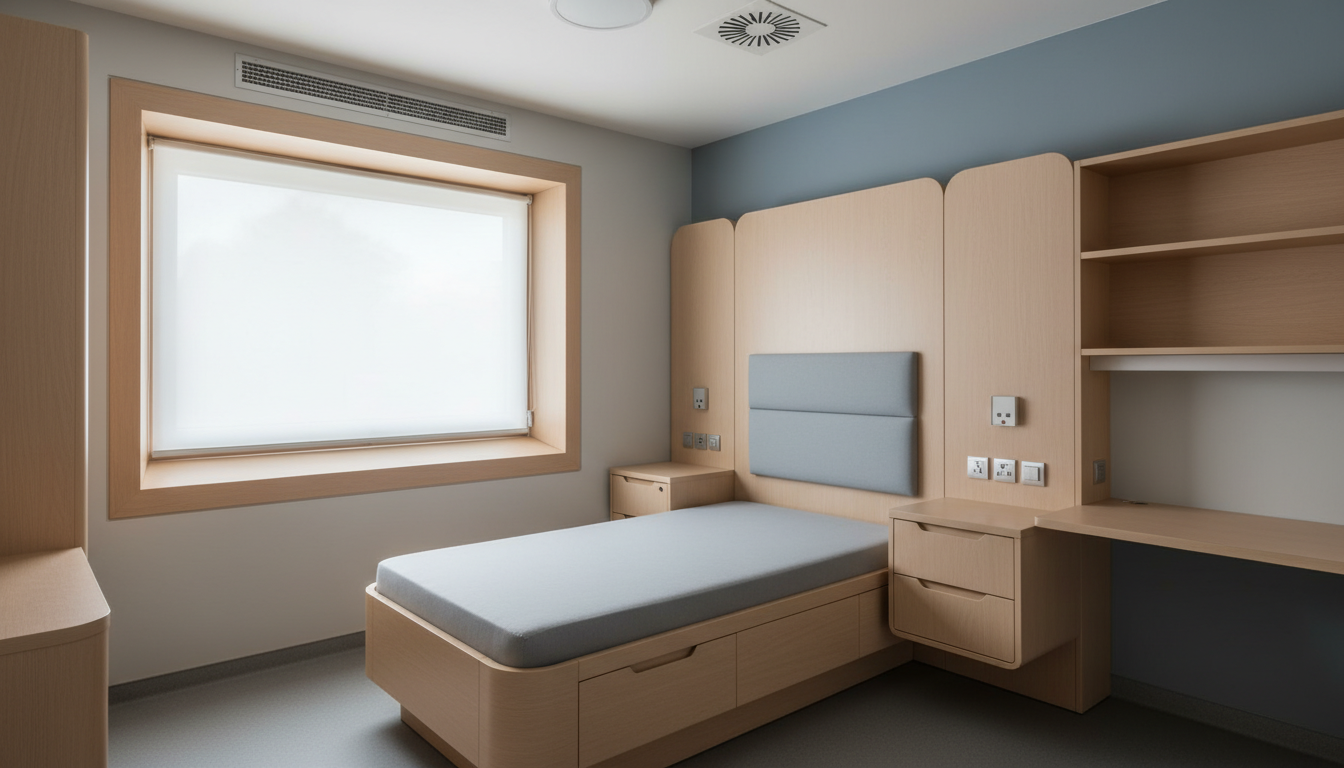
In bedrooms, the focus shifts to window treatments, lighting, and HVAC components. Standard curtains with cords are strictly prohibited. The modern standard involves breakaway tracks—where the entire track or the carrier clips release under a specific weight (typically 5-10 lbs)—or internal blinds housed between two panes of tempered glass. Lighting must be recessed and utilize impact-resistant polycarbonate lenses. HVAC grilles must feature “perforated” patterns (with holes no larger than 2-3mm) rather than traditional louvers, which are notorious anchor points.
| Fixture | Standard Risk | Anti-Ligature Solution |
|---|---|---|
| Door Handle | Lever | Recessed Pull or Sloped Knob |
| Coat Hook | Rigid Hook | Collapsible/Breakaway Hook |
| Window Treatment | Cords/Blinds | Wand-less / Between-glass blinds |
Door and Hardware Specifications
Doors represent one of the most complex challenges in behavioral health facility management. A door is not just an entry point; it is a potential ligature point at the top, a potential barricade point, and a potential weapon if removed from its hinges. The technical specifications for behavioral health doors are vastly different from standard commercial grade hardware.
Continuous Hinges and Door Tops
Standard “butt” hinges create gaps that are easily utilized for ligatures. The industry standard is the continuous hinge (often called a piano hinge). These hinges run the full length of the door, eliminating gaps. However, even with a continuous hinge, the top of the door remains a risk. To mitigate this, many facilities utilize “sloped-top” doors or “door-top sensors” that trigger an alarm at the nurse’s station if weight is detected on the upper edge of the door.
Ligature-Resistant Locks and Pulls
Levers are replaced with specialized hardware such as “crescent” pulls or sloped knobs. These designs are engineered so that any cord or fabric placed over them will simply slide off. Furthermore, the locks must feature “emergency override” functions. If a patient attempts to barricade themselves in a room, staff must be able to gain access immediately. This often requires double-acting doors that can swing outward in an emergency, even if the patient is leaning against the door on the inside.
Furniture: Weighted and Durable
In a behavioral health setting, furniture must be more than just comfortable; it must be “ballasted” or “fixed.” Facility managers must consider the “weaponization” factor. Any piece of furniture that can be picked up and thrown is a risk to both staff and other patients.
Weighted Furniture Solutions
Seating and tables are often “weighted”—meaning they are manufactured with internal cavities that are filled with sand or heavy pellets at the factory. A standard-looking lounge chair may weigh upwards of 150 lbs, making it nearly impossible for an individual to lift or throw. Alternatively, furniture can be floor-mounted using tamper-proof bolts, though this limits the flexibility of the space.
Material Integrity and Design
Durability is a key component of safety. Behavioral health furniture should be constructed from high-impact, medical-grade polymers or reinforced wood. All edges must be rounded (radiused) to prevent injury during a fall or an outburst. Upholstery is another critical technical choice; it must be puncture-resistant and feature “security seams” that cannot be easily ripped to create a ligature. At DIG Interior Design, we emphasize that durability does not have to sacrifice aesthetics, but the technical specs must come first.
Balancing Safety with Therapeutic Environment
While the technical requirements of anti-ligature design are stringent, the ultimate goal of a behavioral health facility is healing. There is a growing body of evidence suggesting that “institutional-looking” environments can actually increase patient agitation and prolong recovery times. This has led to the rise of “Salutogenic Design”—design that focuses on wellness and the human spirit.
The modern challenge for healthcare administrators is to implement these high-level safety standards while maintaining a “warm” and “normalized” atmosphere. This involves choosing colors that are calming but not sterile, and selecting anti-ligature fixtures that look like residential hardware. For example, choosing wood-grain finishes for weighted furniture or integrating nature-based imagery into impact-resistant wall panels can significantly improve the patient experience.
Successful implementation requires a partner with deep expertise in regulated environments like Behavioral Health. Whether it is a new build or a renovation of an existing wing, the integration of safety and style is a delicate balance. Our work on projects like Residential Treatment in Glen Cove, NY demonstrates how high-security requirements can be woven into a sophisticated, therapeutic interior that feels like a home rather than a hospital.
Ongoing Compliance and Maintenance
Finally, anti-ligature design is not a “set it and forget it” endeavor. Facility managers must conduct regular “Environmental of Care” (EOC) rounds. Over time, caulking around plumbing fixtures can shrink, creating gaps. Screws can loosen, or breakaway features can be damaged. A robust facility management plan includes a checklist for inspecting all ligature-resistant hardware monthly to ensure that the safety integrity of the unit remains intact.
Frequently Asked Questions
Q: What does anti-ligature mean?
A: It refers to design features and hardware specifically engineered to prevent the attachment of a ligature (such as a cord, rope, or piece of clothing) to minimize the risk of self-harm or accidental strangulation in high-risk environments.
Ensure your facility meets the highest safety standards without compromising on therapeutic design. Contact our specialists today to audit your environment.