Urgent care and primary care facilities may appear similar at a glance—exam rooms, waiting areas, support spaces—but they operate under fundamentally different conditions. Those differences aren’t just clinical. They directly shape how these environments need to be designed.
Where projects often fall short is in applying a one-size-fits-all approach. Layouts, workflows, and patient expectations are treated as interchangeable, when in reality, urgent care and primary care demand different spatial strategies. When those distinctions aren’t addressed early, the result is a facility that functions, but doesn’t perform.
Patient Flow Is Predictable in Primary Care—And Constantly Variable in Urgent Care
Primary care environments operate on scheduled appointments. Patient flow is controlled, predictable, and distributed throughout the day. This allows for more structured layouts and a steady operational rhythm.
Urgent care operates differently. Volume fluctuates, arrivals are unscheduled, and peak periods can create immediate pressure on space and staff.
This is where design needs to respond. Urgent care layouts must support rapid intake, flexible patient movement, and the ability to scale under pressure. Waiting areas, triage zones, and exam rooms need to work together to absorb variability without creating bottlenecks.
Primary care, by contrast, benefits from layouts that support continuity—clear patient progression, consistent room use, and efficient provider workflows over a more controlled schedule.
Designing both the same way typically leads to inefficiencies in one—or both.
Front-End Experience Sets the Tone in Urgent Care
In urgent care, the front-of-house experience carries more operational weight than many teams anticipate. Patients arrive without appointments, often in discomfort, and expect to be seen quickly.
Where urgent care environments break down is at intake. Undersized reception areas, unclear check-in processes, or limited triage capacity create immediate congestion. That congestion carries through the rest of the visit.
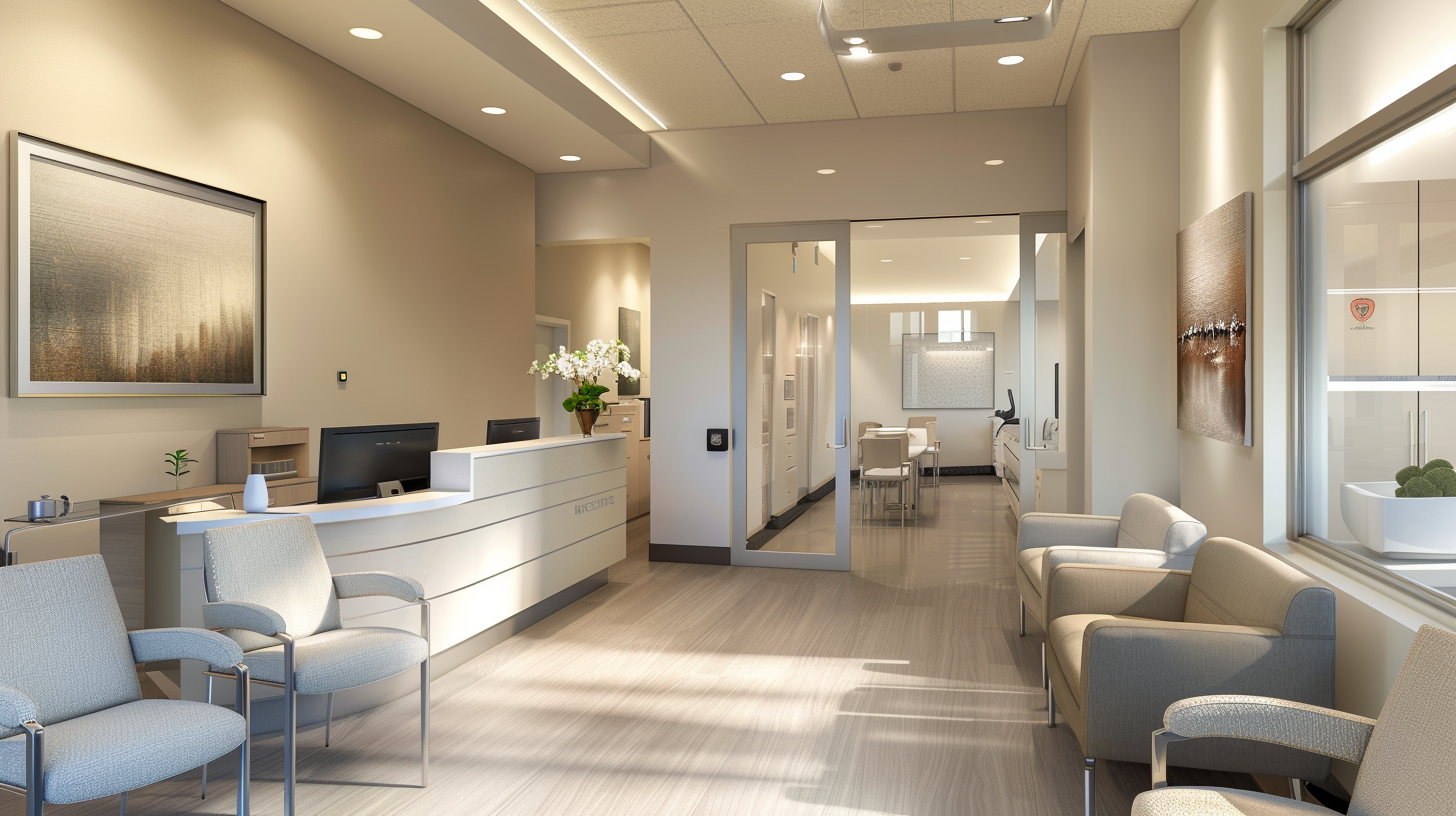
Effective urgent care design prioritizes clarity and speed at the front end. Visible check-in points, defined waiting zones, and clear patient routing reduce confusion and improve throughput.
Primary care environments don’t carry the same pressure at arrival. While experience still matters, the emphasis is less on speed and more on comfort, privacy, and continuity of care.
Exam Room Utilization Follows Different Patterns
Exam rooms in primary care are typically assigned to providers or scheduled based on appointments. Turnover is more predictable, and rooms can be standardized around consistent use.
In urgent care, room utilization is more dynamic. Patients move through based on acuity and availability, not schedule. This creates a need for flexibility in how rooms are accessed and used.
Where urgent care layouts struggle is when exam rooms are not positioned to support continuous flow. If rooms are too isolated, or if support spaces are not immediately accessible, turnover slows and throughput drops.
Primary care environments can prioritize consistency. Urgent care environments need to prioritize adaptability.
Support Spaces Drive Efficiency Differently
Both facility types rely on support spaces—supply rooms, staff work areas, and clinical support zones—but how those spaces are used varies significantly.
In urgent care, proximity is critical. Supplies, medications, and equipment need to be immediately accessible to support rapid patient turnover. Delays at this level directly impact overall volume.
In primary care, workflows are more controlled, allowing for slightly more flexibility in how support spaces are organized. The emphasis shifts toward provider efficiency and patient interaction rather than rapid cycling.
We often see urgent care facilities underperform because support spaces are designed with primary care assumptions. That mismatch shows up quickly in operations.
Waiting Areas Reflect Different Expectations
Waiting areas are often one of the most visible differences between these two models.
In urgent care, waiting is expected—but not for long. Patients are highly sensitive to perceived delays, and overcrowded or poorly organized waiting areas amplify that perception.
Layouts need to support real-time visibility, clear communication, and the ability to manage fluctuating volumes. Overflow conditions should be anticipated, not improvised.
In primary care, waiting is more predictable. Patients arrive at scheduled times, and while delays still occur, expectations are different. Waiting areas can prioritize comfort, privacy, and a more relaxed environment.
Designing urgent care waiting areas like primary care spaces often leads to congestion and frustration during peak periods.
Staff Workflow Is More Linear in Primary Care
Primary care workflows tend to follow a more linear pattern: patient arrives, is roomed, seen by a provider, and discharged. This allows for layouts that reinforce that sequence with minimal disruption.
Urgent care workflows are less predictable. Patients may require different levels of attention, additional diagnostics, or extended stays depending on condition.
This variability places more pressure on layout. Staff need clear visibility, efficient circulation, and immediate access to resources to adapt in real time.
Where urgent care environments fall short is when layouts assume a linear process that doesn’t reflect actual operations.
Designing for Volume vs. Continuity
At a high level, the distinction comes down to what each environment is optimizing for.
Urgent care is built around volume. The goal is to move patients through quickly and efficiently while maintaining quality of care.
Primary care is built around continuity. The focus is on longer-term relationships, consistency, and a more controlled pace of interaction.
These priorities influence everything from layout to material selection to overall patient experience.
When those priorities are not clearly defined during design, the facility ends up trying to serve both models—and underperforming at each.
Coordination Aligns Design With Reality
Both urgent care and primary care projects involve multiple stakeholders—operators, clinicians, designers, and contractors. Each brings different expectations for how the space should function.
Where projects tend to break down is when those expectations are not aligned early. Design decisions that don’t reflect actual workflows create friction that becomes visible during operations.
Early coordination ensures that layout, flow, and support spaces reflect how the facility will actually be used. Without that alignment, even well-designed spaces can struggle to perform.
Different Models Require Different Design Strategies
Urgent care and primary care may share similar components, but they are not interchangeable models. Each requires a design approach that reflects its operational reality.
Facilities that recognize this early—aligning layout, flow, and patient experience with the intended model—are more likely to perform as expected.
Those that don’t often encounter the same issue: the space works, but it doesn’t work well.
And in healthcare, that difference is what defines long-term success.