Retail environments are no longer just places to display products. They are behavioral systems designed to influence how customers move, what they notice, how long they stay, and ultimately what they purchase.
By 2026, the role of retail design has shifted even further away from simple merchandising and toward experience-driven spatial strategy. Customers have become more selective about where they spend time physically, especially as online shopping continues to absorb transactional purchases.
This means brick-and-mortar environments need to do more than function. They need to guide behavior intuitively—without relying on excessive signage, forced interaction, or overt direction.
The most effective retail spaces achieve this subtly. Customers feel comfortable and naturally move through the environment in ways that align with operational goals, often without realizing the space itself is influencing those decisions.
Layout Determines Movement Before Products Do
One of the most misunderstood aspects of retail design is the assumption that products alone drive engagement. In practice, layout determines whether customers encounter those products effectively in the first place.
Entry conditions, circulation paths, sightlines, and transition zones all influence how customers move through a store.
Where retail environments struggle is in creating layouts that are either too rigid or too undefined. Overly controlled circulation can feel forced and uncomfortable. Poorly organized layouts create confusion and reduce dwell time.
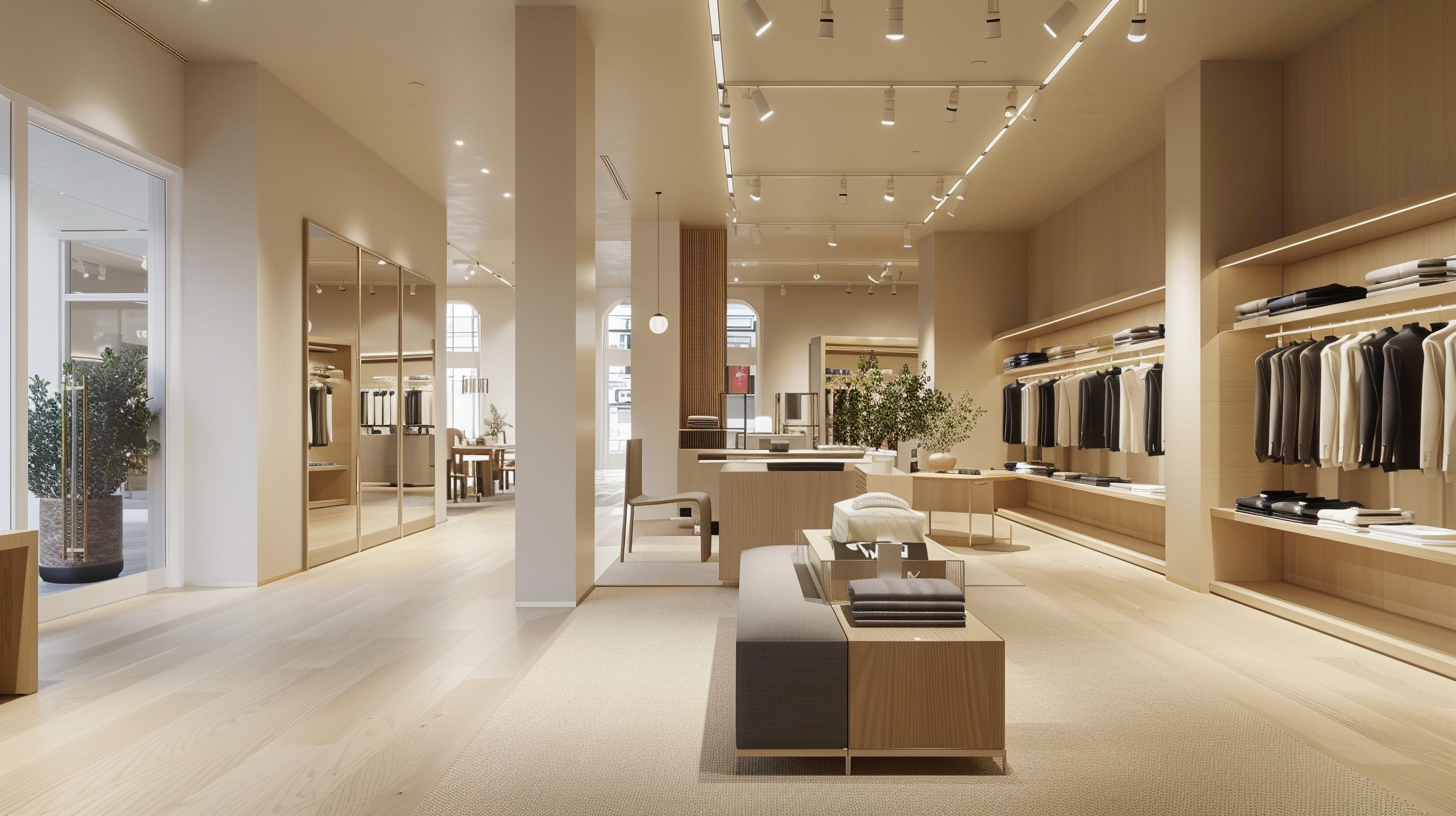
The most effective environments establish subtle directional cues through architecture, lighting, product placement, and spatial compression or expansion.
Good retail flow feels natural—even when it is carefully orchestrated.
The First 30 Feet Shapes Customer Behavior
The entry sequence is one of the most critical zones in retail design. Customers transition quickly from an external environment into the store, and that transition affects how they engage with the space.
Where many retailers fail is in overcrowding the entrance with messaging, displays, or promotional elements before customers have had time to orient themselves.
This creates cognitive overload immediately.
Effective entry zones allow customers to decompress, understand the environment, and establish visual bearings before deeper engagement begins.
This is where sightlines become critical. Customers should immediately understand where key product zones, circulation paths, and focal points are located without needing explicit instruction.
Customers Follow Visual Energy
Movement through retail environments is heavily influenced by visual energy—the areas of contrast, activity, lighting, and spatial interest that attract attention naturally.
This is why some areas of a store consistently attract traffic while others remain underutilized.
Retailers often assume underperforming areas require more signage or promotional messaging. In many cases, the issue is spatial hierarchy.
Customers are drawn toward environments that feel active, open, and visually legible. Dark corners, compressed circulation, or visually flat areas tend to reduce movement.
Lighting, ceiling variation, feature displays, and material transitions all help create subtle movement cues without overt direction.
Product Density Directly Affects Dwell Time
There is a tendency in retail to maximize product exposure by increasing density. In reality, excessive density often reduces engagement.
When environments become visually crowded, customers process less information—not more. Decision fatigue increases, movement slows, and attention narrows.
This is particularly relevant in premium or experience-driven retail environments where discovery and browsing are part of the value proposition.
Negative space matters. Strategic spacing between displays allows products to feel more intentional and easier to engage with.
Customers tend to spend more time in environments where information feels manageable rather than overwhelming.
Circulation Needs Rhythm
Retail flow is not just about moving customers efficiently from one point to another. It’s about controlling pace.
Strong retail layouts create rhythm through alternating moments of openness, compression, pause, and transition.
This rhythm affects:
– How quickly customers move
– Where they stop
– What captures attention
– How long they remain engaged
Where stores struggle is in maintaining a single spatial condition throughout the environment. Uniform layouts create predictable movement and reduce discovery.
Variation keeps customers engaged without requiring conscious effort.
Technology Needs to Support the Environment, Not Dominate It
Technology continues to play a larger role in retail, from digital signage to self-checkout to interactive displays.
Where many environments fail is in allowing technology to compete with the spatial experience itself.
Overly aggressive digital integration can create visual noise and reduce clarity within the environment. Customers become overstimulated rather than engaged.
The most effective retail environments integrate technology selectively, using it to reinforce navigation, product interaction, or operational convenience without overwhelming the physical space.
Technology should support flow—not interrupt it.
Retail Design Is Behavioral Design
At its core, retail design is not about aesthetics alone. It is about shaping behavior.
Every design decision influences:
– Where customers move
– What they notice
– How comfortable they feel
– How long they stay
The most successful environments guide these behaviors subtly, creating spaces that feel intuitive and easy to navigate.
Customers rarely articulate why a retail environment feels good to shop in.
But they respond to it behaviorally almost immediately.
The Best Retail Environments Feel Effortless
Retail spaces perform best when the customer journey feels natural rather than engineered.
Layouts that are too aggressive become obvious. Layouts that are too passive fail to guide behavior effectively.
The balance comes from understanding how people move through environments psychologically—not just physically.
By 2026, the retailers outperforming competitors are not necessarily the ones with the most technology or the largest footprints.
They are the ones designing environments that quietly influence behavior while making the customer experience feel effortless.