First impressions matter.
In a home, the entryway is often the first space people experience and the last space they see before leaving. It sets the tone for everything that follows.
Yet despite its importance, the entryway is frequently one of the most cluttered areas in the home.
Shoes accumulate near the door. Mail piles up on surfaces. Bags, jackets, keys, and miscellaneous items compete for limited space.
The challenge is not usually a lack of effort.
It’s a lack of planning.
The most successful entryways are designed around how people actually live. They combine storage, organization, and aesthetics in a way that supports daily routines while maintaining a welcoming appearance.
Clutter Is Often a Design Problem
Many people view clutter as an organizational issue.
In reality, clutter often results from missing infrastructure.
If there is no designated place for keys, they end up on a countertop. If coats lack a proper home, they migrate to chairs and furniture. If shoes have nowhere to go, they collect near the door.
People naturally choose the path of least resistance.
Good design recognizes this behavior and creates convenient storage solutions where they are needed most.
When systems align with daily habits, organization becomes significantly easier.
Everyday Items Need Dedicated Homes
The foundation of a clutter-free entryway is assigning specific locations for frequently used items.
Common examples include:
- Keys
- Wallets
- Sunglasses
- Backpacks
- Coats
- Shoes
- Dog leashes
Without dedicated storage, these items naturally accumulate on available surfaces.
The goal is not necessarily adding more storage.
It is creating the right storage.
Closed Storage Creates Visual Calm
Open storage can be useful, but it often requires ongoing discipline to maintain a tidy appearance.
For many households, closed storage offers greater flexibility.
Cabinets, drawers, baskets, and concealed compartments help reduce visual noise while still providing easy access to frequently used items.
This is particularly important in smaller entryways where clutter can quickly overwhelm the space.
By hiding everyday necessities, the environment feels more organized even during busy periods.
Benches Are More Functional Than They Appear
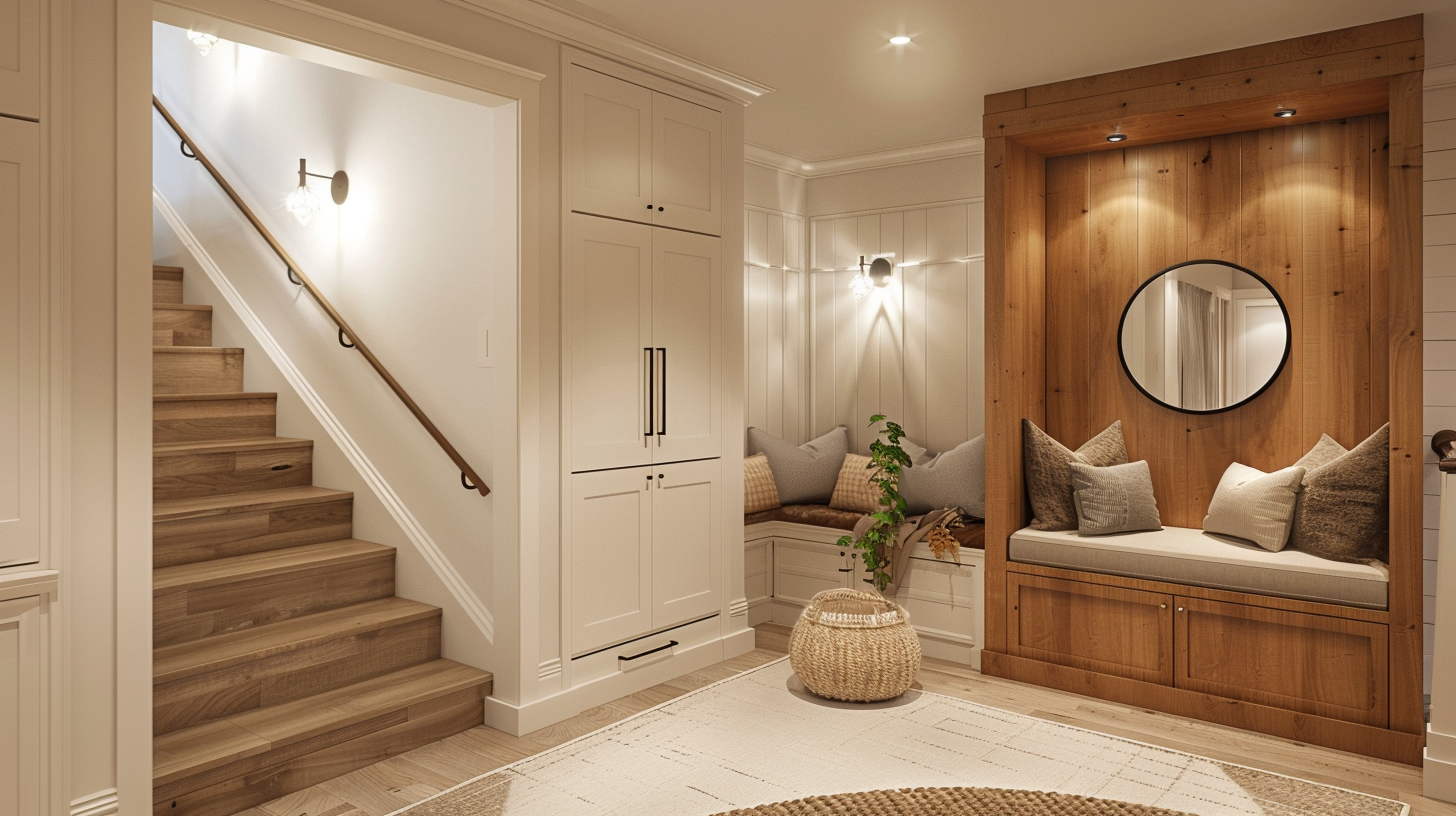
One of the most valuable additions to an entryway is often a simple bench.
Beyond providing a place to sit while putting on shoes, benches help anchor the space and support daily routines.
Many designs also incorporate hidden storage beneath the seat, creating an opportunity to store seasonal items, footwear, or accessories.
Because they combine comfort and functionality, benches are frequently one of the highest-performing pieces in an entryway.
Vertical Space Is Often Untapped
When floor space is limited, walls become increasingly valuable.
Hooks, shelving, cabinetry, and wall-mounted organizers can dramatically increase storage capacity without reducing circulation space.
Effective vertical storage solutions often include:
- Coat hooks
- Floating shelves
- Mail organizers
- Wall-mounted cabinets
- Built-in millwork
These features allow entryways to remain functional without feeling crowded.
Lighting Shapes First Impressions
Storage may be the practical priority, but lighting plays a significant role in how an entryway feels.
A well-lit entryway feels welcoming and intentional.
Poor lighting can make even organized spaces feel smaller and less inviting.
Layered lighting strategies often work best.
Combining ambient lighting with decorative fixtures or accent lighting helps create both functionality and atmosphere.
Because the entryway introduces the home, it deserves the same design attention as any other room.
Mirrors Serve More Than One Purpose
Mirrors are a common feature in entryways for good reason.
They provide practical value before leaving the house, but they also influence how the space feels.
Mirrors reflect light, create a greater sense of openness, and help compact entryways feel larger than they actually are.
When paired with thoughtful lighting, they can dramatically improve the perception of space.
Organization Should Be Easy to Maintain
The best organizational systems are not the most complicated.
They are the easiest to use consistently.
If a storage solution requires excessive effort, it is unlikely to become part of a daily routine.
Successful entryway design focuses on convenience.
The easier it is to put something away, the more likely people are to do it.
This simple principle often determines whether an entryway remains organized over time.
Creating a Better First Impression
A clutter-free entryway is not simply about cleanliness.
It is about creating a space that supports daily life while making a positive first impression.
Thoughtful storage, proper lighting, functional furniture, and intuitive organization all contribute to a more welcoming environment.
Because the best entryways do more than greet guests.
They make everyday life a little easier for the people who use them most.