When most people hear the phrase “spaceship-themed room,” they immediately picture a child’s bedroom filled with glow-in-the-dark stars and toy rockets.
While those spaces certainly have their place, futuristic design has evolved far beyond children’s decor.
Today’s interpretations draw inspiration from aerospace engineering, science fiction, advanced materials, and minimalist architecture to create sophisticated interiors that feel immersive without becoming gimmicky.
In many ways, spaceship-inspired design shares common ground with some of the most influential contemporary design movements. Clean lines, integrated technology, purposeful lighting, and streamlined forms are all concepts that exist both in modern architecture and imagined spacecraft environments.
The key is understanding how to capture the feeling of the future without turning a room into a movie set.
What Makes a Space Feel Futuristic?
Contrary to popular belief, futuristic interiors are not defined by excessive technology or dramatic visual effects.
More often, they are characterized by simplicity and intentionality.
Common elements include:
- Clean geometric forms
- Integrated lighting
- Minimal visual clutter
- Curved architectural details
- Advanced material palettes
- Seamless technology integration
The objective is to create an environment that feels efficient, purposeful, and slightly ahead of its time.
That feeling is often more important than any specific decorative element.
Lighting Does Most of the Heavy Lifting
If there is one feature that consistently defines futuristic interiors, it is lighting.
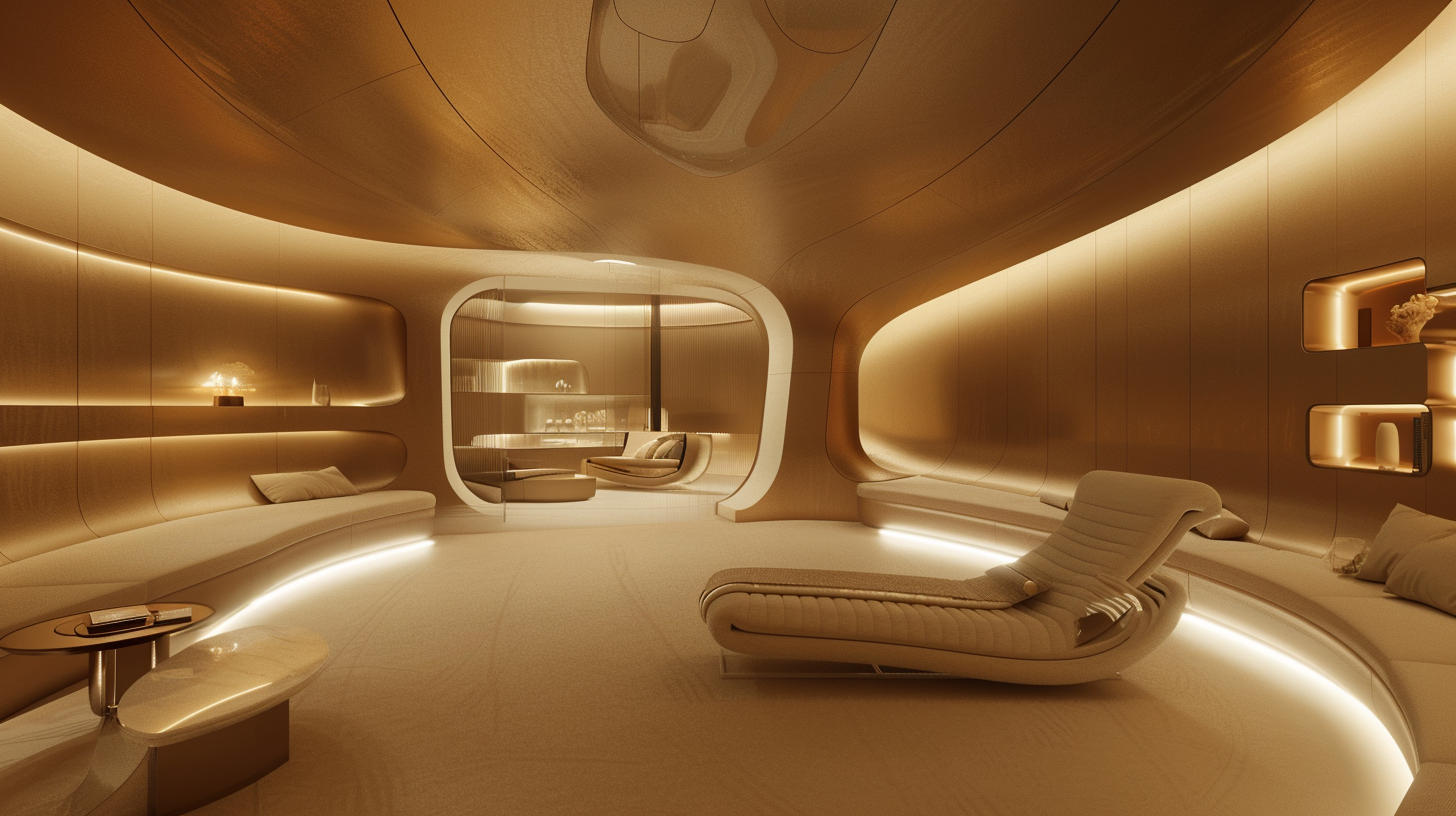
Integrated LED systems, indirect illumination, cove lighting, and architectural lighting details create an atmosphere that immediately feels more advanced.
Rather than relying solely on decorative fixtures, futuristic spaces often use light as part of the architecture itself.
Examples include:
- Backlit wall panels
- Floating ceiling details
- Integrated shelving illumination
- Floor-level pathway lighting
- Hidden ambient lighting systems
These techniques create depth while contributing to the immersive quality often associated with spacecraft interiors.
Curves Create a Sense of Motion
Many futuristic environments rely on curved forms rather than traditional right angles.
This design language has roots in both aerospace engineering and industrial design.
Curved walls, rounded furniture, and softened architectural transitions help spaces feel more fluid and dynamic.
Even subtle curves can dramatically change the perception of a room.
The result often feels more contemporary and less rigid than conventional interiors.
Material Selection Matters
Materials play a significant role in creating a futuristic atmosphere.
Designers often balance sleek surfaces with warmth to avoid environments feeling sterile.
Popular material combinations include:
- Matte metals
- Textured composites
- Glass
- High-performance laminates
- Natural wood accents
- Soft acoustic materials
The most successful spaces combine innovation with comfort.
Without warmth, futuristic design can quickly feel cold and uninviting.
Technology Should Feel Invisible
One of the defining characteristics of advanced design is that technology feels integrated rather than added.
Hidden speakers, wireless charging surfaces, automated lighting controls, and integrated displays all contribute to a futuristic experience.
However, visible technology is not the goal.
The strongest environments allow technology to support the experience without dominating it.
In many ways, truly futuristic design feels simpler rather than more complicated.
Spaceship Design and Modern Minimalism Share Common Ground
Many futuristic interiors borrow principles from modern minimalist design.
Both emphasize:
- Clean sightlines
- Reduced clutter
- Functional layouts
- Material quality
- Intentional detailing
This overlap explains why contemporary luxury homes, boutique hotels, and high-end workplaces sometimes feel subtly futuristic even when they were never designed around a science-fiction theme.
The underlying principles are remarkably similar.
Immersion Doesn’t Require Extremes
A common mistake is assuming that themed design must be literal.
The strongest spaceship-inspired interiors rarely include obvious references such as rockets, planets, or science-fiction props.
Instead, they focus on atmosphere.
Thoughtful lighting, innovative materials, curved forms, and integrated technology can create a futuristic feeling without sacrificing sophistication.
The result feels timeless rather than trendy.
The Future Is Often More Comfortable Than We Imagine
Perhaps the most interesting evolution of futuristic design is its growing emphasis on comfort.
Earlier visions of the future often celebrated technology at the expense of warmth.
Today’s interpretations recognize that successful environments must support both innovation and wellbeing.
This shift has produced interiors that feel advanced while remaining welcoming and highly livable.
Spaces that inspire curiosity without sacrificing comfort.
Designing for Imagination
Spaceship-inspired interiors are ultimately about possibility.
They encourage designers to think differently about materials, lighting, technology, and spatial experience.
When approached thoughtfully, these concepts can create environments that feel unique, immersive, and surprisingly sophisticated.
Because futuristic design is not really about spaceships.
It’s about imagining what spaces could become.